Capt Olubowale Urges FG to Take Advantage of UTM Offshore FLNG Project in Advancing Blue Economy Sector
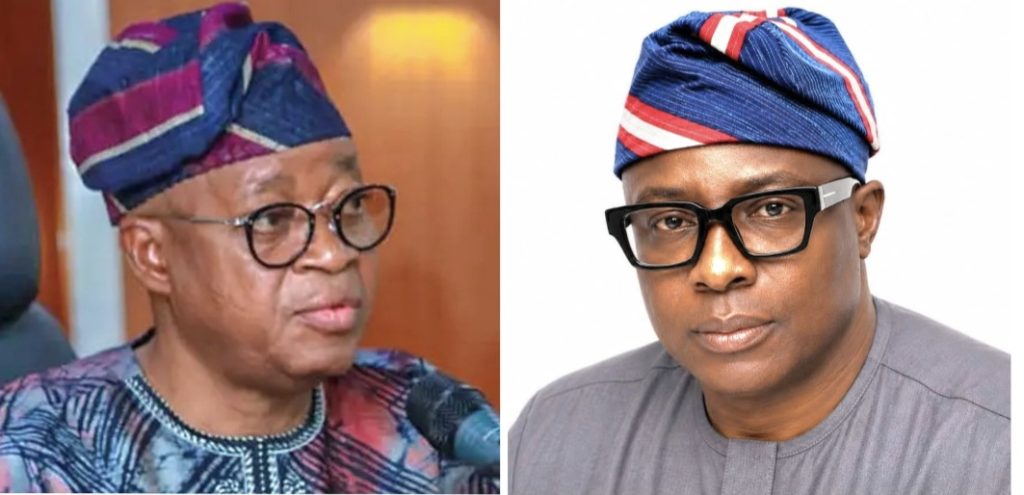
Minister of Marine and Blue Economy, Adegboyega Oyetola (left) and Capt Ladi Olubowale, CEO of Seamate Maritime Integrated Services Limited

The Federal Ministry of Marine and Blue Economy, under the leadership of Minister Adegboyega Oyetola, has been advised to seize the huge opportunity presented by the UTM Offshore Floating Liquefied Natural Gas (FLNG) Project to transform Nigeria’s maritime economy, strengthen indigenous shipping, and capture billions of Naira in economic value that have historically flowed offshore.
The Presidency, the Federal Ministry of Marine and Blue Economy, the Federal Ministry of Petroleum Resources, NNPC Limited, Nigerian Maritime Administration and Safety Agency, the Nigerian Content Development and Monitoring Board, financial institutions, and private investors were enjoined to align the UTM FLNG Project with a national strategic fleet development agenda.
The UTM Offshore Floating Liquefied Natural Gas (FLNG) Project, Nigeria’s first indigenous-led FLNG development, is designed to monetize stranded gas resources, increase LNG exports, create jobs, strengthen government revenues, and reinforce Nigeria’s position in the global energy market. It gives us the chance to move beyond exporting resources towards building industries.
A distinguished Master Mariner and Group Managing Director/CEO of Seamate Maritime Integrated Services Limited, Captain Ladi Olubowale, gave this counsel at an industry review on beyond Nigeria producing gas towards developing capability, in Lagos recently.
Speaking on “Beyond Gas: Why the UTM Offshore FLNG Project Should Launch Nigeria’s Maritime Industrial Revolution,” Captain Ladi Olubowale posited that the gas project should be used to launch Nigeria’s maritime industrial revolution, saying “Because nations that own their ships, own their supply chain. And nations that own their supply chains shape their own economic destiny.”
Captain Olubowale, the immediate past President of the African Shipowners Association (ASA) Nigeria, said this is very important for Nigeria because it possesses over 200 trillion cubic feet of proven natural gas reserves and one of Africa’s largest offshore energy industries, maintaining that gas alone will not transform our economy while transformation comes from building industries around gas.
Olubowale, who is an Ambassador of International Seafarers’ Welfare and Assistance Network UK, noted “Its development and long-term operation will require a broad range of offshore support vessels, marine logistics services, crew transfer operations, emergency response capabilities, security patrols, marine engineering, subsea support, and technical maintenance.
“Each of these represents an industry. Each creates employment. Each generates taxes. Each retains wealth within Nigeria—if Nigerians own the assets and provide the services.”
He added that If the UTM FLNG Project is properly aligned with a national strategic fleet development agenda, the benefits would extend far beyond one energy project.
According to him, “We will create jobs. Retain foreign exchange. Deepen local content. Strengthen our maritime security. Develop world-class expertise. Enhance investor confidence. Build globally competitive Nigerian companies. And secure a larger share of the economic value generated by our own natural resources.
“The UTM Offshore FLNG Project should not stand alone as an energy project. It should become the foundation of Nigeria’s Maritime Industrial Revolution. Every molecule of gas exported should generate Nigerian freight, Nigerian jobs, Nigerian financing, Nigerian ship management, Nigerian insurance, Nigerian seafarers, and Nigerian prosperity.
“The measure of our success will not be how much gas we export, but how much national wealth we retain. Nations become maritime powers not by owning cargo alone, but by owning the ships, the supply chains, the technology, and the institutions that move commerce. Nigeria now has a once-in-a-generation opportunity to build that future.
“We must seize it—not simply to serve one FLNG project, but to establish a Strategic National Fleet that will carry Nigeria’s economic ambitions across Africa and the world.”
Captain Olubowale emphasized that Nigerian-led FLNG project deserves a strong Nigerian maritime supply chain while imagining significant economic benefits it would accrue to the national economy.
“Imagine the impact if the offshore support vessels servicing this project were increasingly owned and operated by indigenous companies. Thousands of skilled jobs would be created for Nigerian seafarers, marine engineers, naval architects, offshore technicians, and logistics professionals.
“Marine insurance, ship management, legal services, finance, port operations, and maintenance industries would all expand. Young Nigerians graduating from maritime academies would find meaningful careers. Banks would finance productive assets backed by long-term contracts.
“Investors would have confidence in the sector. This is how industrial ecosystems are built,” said he.
Citing Norway and Qatar as countries that have successfully utilised their gas potential to grow their maritime economy, Captain Ladi Olubowale said the UTM FLNG Project should not simply be viewed as an LNG facility but an anchor project for Nigeria’s maritime industrial transformation.
According to him, “Norway did not become a global maritime powerhouse simply because it discovered offshore oil. It deliberately built Norwegian-owned offshore service companies, engineering firms, maritime financial institutions, ship management expertise, and highly skilled seafarers. Qatar did not become one of the world’s leading LNG exporters by producing gas alone.”
Olubowale pointed out that the Cabotage Vessels Finance Fund (CVFF) has a critical role to play in the UTM Offshore FLNG Project, not just vessel financing but must finance productive maritime assets linked to commercially viable projects with long-term demands which they project offers.
“This is where the Cabotage Vessel Financing Fund (CVFF) assumes national importance. For years, discussions around the CVFF have focused almost exclusively on vessel financing. That conversation must now evolve. The CVFF should be viewed as a strategic economic development instrument. Its purpose should not simply be to purchase ships.
“Its purpose should be to finance productive maritime assets linked to commercially viable projects with long-term demand. The UTM FLNG Project offers exactly such an opportunity.
“With predictable offshore logistics requirements extending over many years, it provides the commercial certainty needed by banks, investors, and indigenous shipowners.
“This is how successful maritime economies develop—not by financing vessels in isolation, but by connecting finance with guaranteed economic activity,” he said.
For the full actualisation of the project, the Seamate boss canvassed for private sector operators to drive it, maintaining that government, whose role is to create suitable environment, would not be able to build it alone. “Government alone cannot build this future. Nor should it. Around the world, successful maritime economies have been driven by private enterprise, supported by enabling public policy.
“The role of government is to create the environment. The role of the private sector is to innovate, invest, and execute. The UTM FLNG Project demonstrates the capacity of Nigerian entrepreneurs to deliver globally significant energy infrastructure.
“The next step is to ensure that indigenous shipowners, financial institutions, technology providers, insurers, and logistics companies become equal partners in this transformation. This is not protectionism. It is strategic economic development.”
Concluding, Olubowale submitted “The true measure of national success is not the quantity of resources we export, but the value we retain.
“That decision will define whether this project becomes another successful energy investment—or the catalyst for a new era of industrial development.”