Blue Economy Ministry Set to Approve Digital Pricing Framework for Freight Forwarding Services
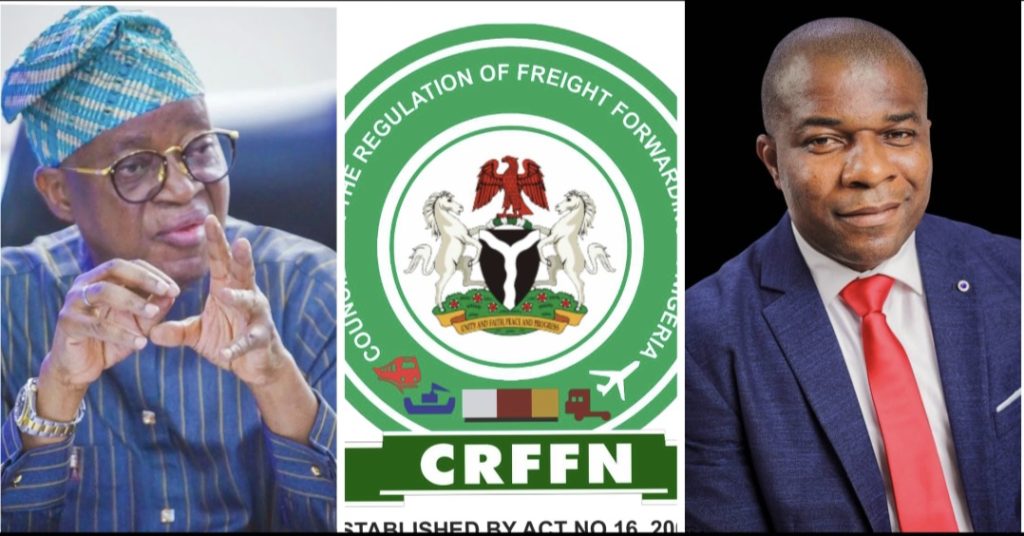
The Minister of Marine and Blue Economy, Adegboyega Oyetola (left) CRFFN logo (inset) and the Registrar of CRFFN, Mr Kingsley Igwe

By DAPO OLAWUNI
The Federal Ministry of Marine and Blue Economy is preparing to approve a digital standardization and price determination framework for freight forwarding services, covering haulage and customs clearance, a development that could fundamentally reshape how logistics costs are structured and communicated across Nigeria’s maritime sector.
This indication was given last Friday by the Registrar of the Council for the Regulation of Freight Forwarding in Nigeria (CRFFN), Mr. Kingsley Igwe, at a town hall meeting organised by JournalNG in Lagos.
Igwe disclosed that the proposal, already submitted to the Ministry, was part of a broader effort to bring predictability, transparency, and global best practice to freight forwarding charges in Nigeria, a sector long plagued by opaque, lump-sum pricing that leaves both shippers and agents exposed to financial risk.
“We have started the standardization and price determination for freight forwarding services, including haulage and customs clearance
“Today, if you want to clear your consignment, you don’t even know how much the agent’s service charge is because everything is lump sum. So, we did a study to establish standards that will guide the industry. For haulage, what we did was to make comparisons with several other countries, how is haulage charged? They charge per kilometre, including all the necessary cost components such as wear and tear, value, insurance, risk and everything on the truck,” the CRFFN boss explained.
Igwe said the proposal was currently being reviewed at the Ministry level, with stakeholder engagement planned once approval is secured.
“My proposal is there at the Ministry, it’s being worked on. By the time it’s been approved, then we’ll hold an intensive stakeholder engagement for the implementation process to be defined,” he said.
The CRFFN Registrar grounded the initiative in a World Trade Organization framework, noting that the WTO had established a three-part solution for addressing the unpredictability of logistics costs globally.
“I talked about predictability of logistics services and logistics cost. The World Trade Organization established a three-part solution. One of it is standardization. Upon that block, every other country set up an SOP, standardizing pricing mechanisms, processes or even procedures: port procedures, customs procedures, haulage procedures and even freight forwarding pricing, including haulage pricing. That means standardizing based on certain parameters. But it’s not so here, and that was why we tried to inculcate this last year,” Igwe stated.
Beyond transparency for shippers, Igwe painted a sobering picture of the financial hardship quietly endured by freight forwarding agents under the current unregulated pricing environment, pushing back against the popular perception that agents profit enormously from cargo clearance.
“The agents, who most people think go home with a humongous amount of money after clearing, end up broke. Most of them even sacrifice their own money to add to what they are being given because of their inability to predict what it will cost to clear the goods, i have been there. Some of them underestimate just because they want to survive,” he said.
“By the time the goods get a debit note (DN) from customs, the whole money is gone. The shipper refuses to add money. The agent goes back, borrows it in order to please the shipper. He becomes a debtor. End of the day, the consignment comes out. The shipper refuses to pay him back. He is owing somebody. He is dying inside slowly. And we say these freight forwarders take too much money home. It’s not true.
“That’s why we have to define how we can help these people, so that at the end of the day, they can be able to save. After a year of work, they should be able to look back after doing their accounting and have some profit balance at the end of it,” Igwe added.
He said the proposed digital mechanism was specifically designed to address these systemic vulnerabilities by factoring in unforeseen risks without eroding the agent’s fixed service charge.
“The mechanism we are coming out with takes care of every unforeseen risk. It is digital. It would help them input all the necessary risk factors that will take care of the cost without tampering with their own percentage of service charge. The charge is going to be constant whether the risk is high or not, we will now define who, at the point of risk, should bear responsibility. Because even shippers most times are not truthful when they give you a Bill of Lading, and the blame now falls on the agent,” Igwe said.