AMATO, LASTCOC Laud NPA’s Eto Call-up System, Stages Solidarity Rally in Apapa Against Smear Campaign

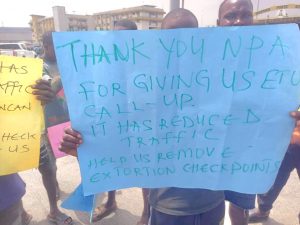
Truckers protesting in Apapa

By DAPO OLAWUNI
Truckers operating under the umbrella of the Association of Maritime Truck Owners (AMATO) and the Lagos State Trucks and Cargo Operators Committee (LASTCOC) have strongly condemned a burgeoning campaign of calumny aimed at discrediting the Nigerian Ports Authority’s (NPA) electronic call-up system, ‘Eto’.

On Wednesday, June 4, 2025, the trucking associations organized a peaceful solidarity rally at the Apapa ports, unequivocally declaring their vote of confidence in the ‘Eto’ system. The demonstration underscored the system’s significant positive impact since its introduction by the NPA.
In a written statement titled “VOTE OF THANKS TO THE NIGERIAN PORTS AUTHORITY (NPA) AND VOTE OF CONFIDENCE IN THE ETO CALL-UP SYSTEM,” made available to DAILY TREND, Muhammed Bala Sanni, the National Secretary of AMATO, also urged the NPA to implement further improvements to enhance the system’s effectiveness.

Addressing the media on behalf of the trucking community during the rally, Sanni stated, “We wish to use this peaceful rally as a platform to express our profound gratitude to the management of the Nigerian Ports Authority (NPA) for the deployment of the Eto Call-Up System, and to also appreciate the Lagos State Government for its vital role in enforcing compliance with the Standard Operating Procedures that underpin the system.”
“The Eto Call-Up System is more than just an app, it is a game-changer and a landmark achievement in the history of Nigeria’s maritime logistics. It has ushered in a new era of automation, transparency, and efficiency in port access and truck scheduling, resolving the long-standing chaos and gridlock that plagued the Apapa and Tin Can Island logistics corridors for decades.”
“Today, truckers can book port access slots remotely and affordably, from anywhere in the world, without the need to physically queue for days on end or engage with road cabals for access tags that used to cost between ₦250,000 and ₦300,000, often without any certainty of progress. The Eto system, at a flat rate of ₦21,500, has eliminated the extortion and exploitation that defined the manual era.” he stated

Thanks to ‘Eto’, the associations noted the following tangible benefits:
* Gridlock has eased, and sanity has returned to our roads.
* Truckers no longer sleep in vehicles or die behind the wheel from exhaustion.
* Port corridors are now more fluid, and the environment more hospitable.
* Import and export cargoes are evacuated seamlessly.
* Businesses now operate on schedule.
* Apapa, once a ghost town, is vibrant again, with rising property values and restored community life.
* Children can now safely attend school without being stranded in traffic.

Despite these significant gains, AMATO and LASTCOC appealed to the NPA to further consolidate these improvements by eliminating all forms of extortion checkpoints, deploying electronic tags (e-tags) to permanently end racketeering, Incorporating a Manifest Scheduler System, and to enhance terminal efficiency to prevent artificial bottlenecks.
The associations also addressed the ongoing campaign of calumny against ‘Eto’, stating their awareness that “some individuals are sponsoring a campaign of calumny against the Eto system. These detractors are largely beneficiaries of the discredited manual system now rendered irrelevant by automation.
“Their interest lies in reversing the clock to a time when truckers were extorted and exploited under the guise of port access facilitation.”
Sanni concluded with a strong rebuke to the system’s critics, saying, “It is ironic, and frankly shameful, that those who once charged ₦250,000–₦300,000 for truck entry now accuse the ₦21,500 Eto system of being fraudulent. If they truly had truckers’ interests at heart, they would have implemented a fair and transparent system during their time.”
He urged vigilance within the trucking community: “We urge all members of the trucking community to remain vigilant. The call-up automation is here to stay and we must resist all attempts to undermine the progress it represents.”
Reaffirming their commitment to the new system, Sanni declared, “The manual call-up system is dead and buried, and any nostalgia for that era must give way to the reality of sustainable, tech-driven port logistics.”
“We say KUDOS to the NPA, the Lagos State Government, and TTP for bringing sanity back to our roads and ports.” he said