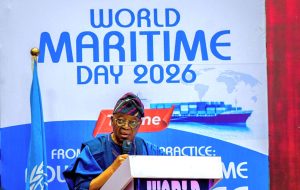
IMION Rallies Customs, NPA, Academia for Blue Economy Trade Facilitation Course in Apapa

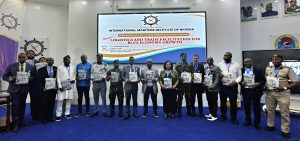
Commandant of the Nigerian Navy Ship (NNS) Quorra Commodore MR Hassan (right) and the Director General of IMION, Rear Admiral Thaddeus Christopher Udofia (rtd) at the opening ceremony of the course in Apapa on Monday.

By DAPO OLAWUNI
Nigeria’s vast maritime wealth cannot translate into sustainable prosperity unless the country urgently tackles port inefficiencies, transaction costs, and weak hinterland connectivity, stakeholders said at the opening of a three-day Executive Course on Logistics and Trade Facilitation for the Blue Economy, organised by the International Maritime Institute of Nigeria (IMION), held in Apapa from September 7 to 9.
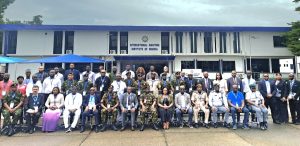
The event had participants from Nigerian Ports Authority (NPA) indigenous terminal operator; SIFAX Group, Nigeria Customs Service, Nigerian Ports Economic Regulatory Agency (NPERA) Nigerian Navy officers, freight forwarders among others.
Declaring the course open, the Director-General of IMION, Rear Admiral Thaddeus Christopher Udofia (rtd), said the theme, “Logistics and Trade Facilitation for Blue Economic Growth,” could not be timelier, describing the blue economy as one of the most significant opportunities for sustainable economic growth, job creation, trade expansion, and regional integration in Nigeria and across Africa.
Udofia noted that Nigeria is endowed with an expansive maritime domain rich in both living and non-living resources, featuring a coastline of about 420 nautical miles, or roughly 853 kilometres, along the Atlantic Ocean, and projecting 200 miles seaward into the exclusive economic zone.
He added that the country’s maritime domain also encompasses vast inland waterways, creeks, estuaries, and the Niger Delta basin, making its seas, waterways, ports, fisheries, coastal resources, and maritime services enormous economic assets.
However, he stressed that converting these assets into sustainable prosperity depends heavily on how efficiently people, goods, information, and services move across the nation’s maritime and trade corridors, placing logistics and trade facilitation at the heart of the challenge.
According to him, efficient logistics reduces the cost of doing business, improves competitiveness, strengthens supply chains, and boosts the capacity of ports and maritime corridors to support international trade.
He also emphasised that effective trade facilitation demands cooperation among a wide range of specialised stakeholders, including customs, port authorities, regulatory agencies, shipping companies, freight forwarders, transport operators, technology providers, and financial institutions.
Udofia called for an end to institutional silos, arguing that the future of the blue economy requires greater collaboration, digitalisation, transparency, interoperability, and coordinated trade policy implementation, particularly as Nigeria continues to underperform on key indicators such as port efficiency and ease of doing business.
He told participants that the course would deepen their understanding of modern logistics systems, customs procedures, port operations, multimodal transportation, supply chain management, and contemporary approaches to trade facilitation, while also examining how these systems can support the sustainable development of Nigeria’s blue economy.
He raised a series of questions for deliberation, including how to reduce delays and transaction costs at ports, how technology and data can improve cargo clearance and supply chain efficiency, how public and private institutions can collaborate more effectively, how policy can encourage investment while maintaining regulation, and how maritime trade growth can translate into employment, economic improvement, financial inclusion, and sustainable development.
Urging participants to treat the course as more than an academic exercise, Udofia encouraged them to share experiences, challenge existing practices, develop solutions, and build lasting professional networks, describing the diversity of the auditorium as one of the course’s greatest strengths.
He noted that officials from Customs and the Nigeria Ports Economic Regulatory Agency bring regulatory and border management experience, maritime and ports executives bring operational perspective, policymakers bring strategic direction, logistics and freight professionals bring practical industry knowledge, while academics and researchers contribute evidence, innovation, and new ideas.
Bringing these perspectives together under what he called the triple helix concept, he said, would help develop solutions that are both ambitious and implementable, integrating the efforts of government, academia, and the maritime industry toward enhanced green economy prosperity.
Looking ahead, Udofia said Nigeria must position itself as a competitive maritime hub within Africa and beyond, which requires investment not only in infrastructure but also in people, knowledge, institutions, and technology.
He outlined the course’s key learning objectives as understanding the foundational principles of the blue economy and its logistics, mapping Nigeria’s key maritime corridors and how infrastructure and logistics shape economic outcomes, diagnosing systemic inefficiencies in Nigeria’s maritime logistics and coastal system while proposing evidence-based solutions, evaluating trade facilitation tools and regulatory frameworks supporting seamless coastal and cross-border trade, and developing a comprehensive logistics and trade facilitation roadmap to drive profitability in transportation across blue economy sub-sectors.
Also speaking at the event, the Director-General of the African Centre for Supply Chain Management, Dr. Obiora Madu, one of the resource persons for the course, said Nigeria loses huge sums annually to port inefficiencies, insisting that the course was important because it would push the conversation toward seeing ports as corridors rather than mere gateways into the economy.
He said a port amounts to little if its hinterland connection is weak, noting that supply chains are end-to-end and must function flawlessly.
Madu said he was confident participants would derive value from the course, arguing that while cost reduction matters in supply chain management, customer service remains the ultimate priority, and that all the costs importers incur as a result of port congestion and related issues are ultimately passed on to the customer.
He further pointed to Nigeria’s poor ranking on the World Bank’s Logistics Performance Index, noting that the index is essentially a reflection of what happens at the nation’s ports, and urged IMION to take up the matter as a subject of research to help improve the country’s standing.
Asked whether participants would get value for their investment in the programme, Madu was emphatic, saying the course would be practical rather than theoretical, drawing on the experience of supply chain professionals who would look beyond pure maritime issues to the broader supply chain cost implications of inefficient port activities.
He added that, having visited the Lome port and other facilities, resource persons would be well positioned to offer comparisons that participants could take home and apply.
Another resource person, Prof Ogochukwu Ugboma, an associate professor and Dean of the School of Transport and Logistics at Lagos State University, who took the module on the Foundations of Blue Economy and its Logistics Framework, said that while many people are familiar with the components of the blue economy, such as maritime trade, coastal resourcing, and tourism, these elements hold no value on their own without a logistics framework to unlock it.
She explained that this framework is essentially about movement, but stressed that movement alone does not capture the full picture, as information flow and financial flow are equally critical, often invisible, elements that can constrain the physical movement of cargo, goods, people, or tourism activity.
Prof Ugboma said understanding these dynamics helps clarify a common misconception about improved cargo throughput.
She noted that while facilities like the Lagos Port Complex and Tin Can Island Port Complex may be functioning well, efficiency cannot be measured by terminal performance alone, pointing to the importance of connectivity, including access roads and gate turnaround times.
She stressed that fixing one aspect of the chain while neglecting others undermines the broader efficiency the sector is striving for, describing it as a combination of interlinked factors that must all work together.