Oyetola Orders Transfer of Inland Dry Ports to NPA, Sets Up Committee for Shippers Council –NPERA Transition

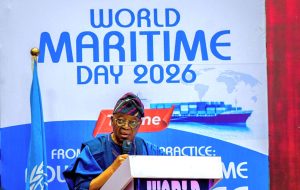
Minister of Marine and Blue Economy, Adegboyega Oyetola

The Minister of Marine and Blue Economy, Dr. Adegboyega Oyetola, has directed the transfer of the inland dry port (IDP) functions of the Nigerian Shippers’ Council (NSC) to the Nigerian Ports Authority (NPA), in a move aimed at creating a clear separation between port economic regulation, development and operations.
In a statement issued by his Special Adviser Dr. Bolaji Akinola in Abuja on Thursday, the Minister also directed the immediate constitution of a ministerial committee to oversee the transition of the Nigerian Shippers’ Council into the newly established Nigeria Ports Economic Regulatory Agency (NPERA), following President Bola Ahmed Tinubu’s assent to the NPERA Act, 2026.
The directives are part of measures to establish a clear institutional framework for the new port economic regulatory regime, eliminate overlapping responsibilities and ensure that agencies under the Federal Ministry of Marine and Blue Economy operate within clearly defined mandates.
The NPERA Act, signed by President Tinubu in August, formally establishes a substantive economic regulator for Nigeria’s port sector, bringing to an end a two-decade wait for a dedicated statutory port economic regulator.
With the enactment of the law, the Nigerian Shippers’ Council, which had operated as the country’s interim port economic regulator since 2014, transmutes into NPERA.
Under the new framework, NPERA is expected to focus primarily on its core economic regulatory responsibilities, including the regulation of tariffs and charges, promotion of competition, licensing, service standards, commercial dispute resolution and protection of port users.
Oyetola said the transition from NSC to NPERA provides an opportunity to establish a regulatory institution that is clearly separated from operational, developmental and promotional responsibilities.
“We must get the transition right. The establishment of NPERA is a landmark reform, and the process of moving from the Nigerian Shippers’ Council to the Nigeria Ports Economic Regulatory Agency must be carefully managed. The ministerial committee will provide the necessary oversight to ensure that the transition is seamless and that every function is domiciled in the appropriate institution,” he said.
The Minister stressed that the credibility and effectiveness of an economic regulator depend, in part, on its ability to function as an impartial referee without being encumbered by responsibilities that could create actual or perceived conflicts of interest.
According to him, the Federal Government’s objective is to ensure that NPERA is allowed to concentrate fully on its statutory regulatory mandate, while functions that are operational, developmental or promotional in nature are transferred to agencies with the appropriate mandates and institutional capacity.
“The emergence of NPERA marks a new chapter in the governance of Nigeria’s port sector. It is therefore important that the new economic regulator is freed from functions that are not compatible with economic regulation. A regulator cannot function as an operator and, at the same time, be expected to be perceived as an unbiased referee,” Oyetola said.
He added that a clear separation of responsibilities would strengthen confidence in the regulatory framework, enhance transparency and create a more predictable operating environment for port users, investors, terminal operators, shipping companies and other stakeholders.
The Minister assured stakeholders that the transfer should not be interpreted as a reduction in the Federal Government’s commitment to the development of inland dry ports across the country. Rather, he said, the objective is to strengthen the IDP programme by placing its promotion within an institution better positioned to integrate the facilities into the nation’s wider port infrastructure and operational network.
“We are committed to strengthening the development of the Inland Dry Ports by placing their promotion within the agency with the appropriate operational and infrastructure mandate. The ultimate objective is to create a more efficient and integrated port system that serves the entire country,” Oyetola added.