
Dangote Refinery Shifts to Bulk Delivery of Product to Depots, Trucks Reduces, Vessel Traffic Rises
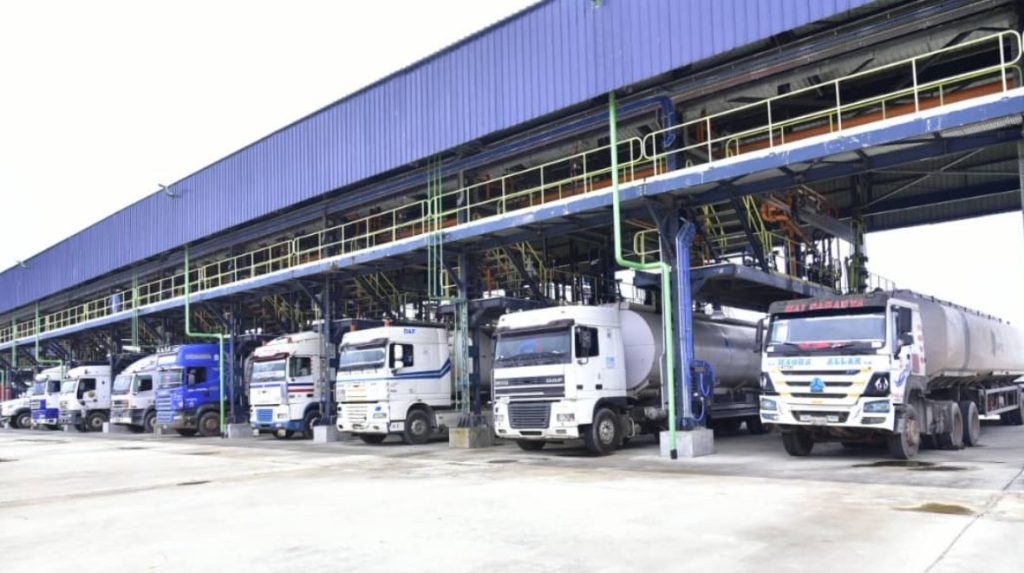

A shift is emerging in Nigeria’s downstream petroleum distribution chain as bulk coastal loading has overtaken truck dispatch at the Dangote Petroleum Refinery, following price alignment between the refinery and private depot operators.
Indications have emerged that Premium Motor Spirit (PMS) prices at major depots are now largely at par with the refinery marketers’ price levels, reducing the incentive for marketers to lift products directly via trucks and increasing reliance on marine supply routes.
This marks a notable transition from December 2025, when the refinery management indicated that truck loading averaged about 1,000 trucks per day. Since then, truck traffic has declined significantly, coinciding with a structured supply arrangement involving selected marketers and depot operators.
Under this framework, about 20 approved marketers continue to lift products from the refinery. These include NIPCO Plc/11 Plc, MRS, TotalEnergies, Conoil, AA Rano, AYM Shafa, Northwest, Rainoil/Eterna, Ardova Plc, and NNPC Retail. Others are Masters Energy, Nepal Energies, Sobaz, Optima, Bovas, Soroman Nigeria Ltd, Heyden, Integrated Oil & Gas, Techno Oil, and Fatgbems.
Market participants say the arrangement has effectively shifted the distribution model toward bulk coastal deliveries to depots, with depot operators now serving as the primary supply interface to retailers.
Recent vessel movements reflect the growing scale of marine logistics. In Lagos, a vessel discharged about 17,000 metric tonnes of Automotive Gas Oil to Ardova, while another cargo of approximately 37,000 metric tonnes of PMS berthed for NIPCO after loading from the refinery. Additional deliveries of around 20,000 metric tonnes of PMS were recorded in Warri and Calabar, contributing to inventory build-up across regional depots.
Across Lagos depots, PMS prices show clear convergence with refinery levels. As of April 22, Bono and Ascon recorded ₦1,204 per litre, while NIPCO, Aiteo, and Gulf Treasure traded around ₦1,204 to ₦1,205 per litre. This pricing parity has narrowed arbitrage opportunities and reduced direct truck loading incentives.
Regional pricing dynamics further reinforce depot-based sourcing. PMS prices in Calabar are around ₦1,227 per litre, while Port Harcourt markets hover near ₦1,218 per litre, encouraging marketers to lift products closer to their distribution zones rather than trucking from the Lekki-based refinery.
The refinery’s location also contributes to the shift. Situated on the outskirts of Lagos, additional transport costs associated with trucking have made depot sourcing more competitive where prices are aligned.
As a result, truck loading activity at the refinery has moderated, while coastal loading has become more visible, supported by sustained vessel traffic and depot replenishment cycles.
The evolving pattern reflects a more structured downstream supply chain, where the refinery supplies in bulk to depots, and depots handle onward distribution to retailers. Current market conditions suggest that coastal logistics will remain a dominant evacuation channel as long as pricing parity and regional supply efficiencies persist.
Source: Petroleumprice.ng