Capt Olubowale Faults Denmark’s Offer of Sea Time for Nigerian Cadets, Says it’s Trade Slavery
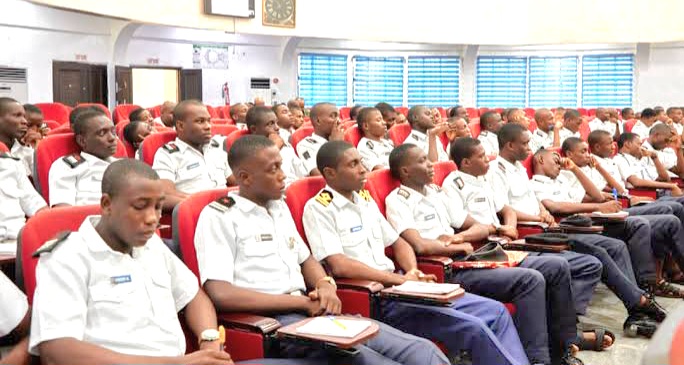
File photo of Seafarers from MAN Oron

Nigeria has been urged to reject a Danish proposal to place its trained cadets on Danish vessels as ratings, with critics warning that it would cast young officers-in-training in roles far below their qualifications.
Captain Ladi Olubowale, Nigeria Ambassador of the International Seafarers’ Welfare and Assistance Network (ISWAN), made the call while reacting to the offer announced by Denmark’s Ambassador to Nigeria, Jens Ole Bach Hansen, during a recent visit to the Nigerian Maritime Administration and Safety Agency (NIMASA) in Lagos. He described the arrangement as demeaning and contrary to Nigeria’s maritime interest.
Olubowale, who is also Managing Director of Seamate Maritime Services Nigeria Limited, explained that a cadet is a trainee officer being groomed to become an Officer of the Watch, Master, Third or Chief Engineer, or Electro-Technical Officer, the specialist in charge of a modern ship’s power, automation and control systems.
Nigerian cadets, he said, need sea-time training, yet what Ambassador Hansen has put to NIMASA Director-General, Dr Dayo Mobereola, amounts to employment at the lowest rank.
Under the IMO’s STCW Convention, these young people (cadets), he said, must complete structured, supervised sea service, documented in an approved Training Record Book, before they can sit for their Certificate of Competency.
Ratings, the ISWAN Ambassador said, are ordinary and able seafarers, oilers, wipers and motormen but very essential members of every crew. Their work is support work: maintenance, mooring, cleaning, painting, lookout and assisting the officers.
Captain Ladi Olubowale, who is the Managing Director of Seamate Maritime Services Nigeria Limited, said what Nigerian cadets need is sea-time training but what Ambassador Jens Ole Bach Hansen is offering to the Director General of NIMASA, Dr. Day Mobereola, is an employment at the lowest rank which is not in the interest of the country.
“This week, Nigerians read that the Danish Government, through discussions with Maersk, is exploring the possibility of engaging Nigerian cadets as ratings on Danish vessels. The news was presented as good news, a gesture of friendship, a door opening for our young seafarers. I have read it more than once, and I must say clearly what many in our maritime community are thinking but may be too polite to say: this is not a good offer. It is not in the interest of the Nigerian cadet, and it is not in the interest of Nigeria’s maritime future. It must be corrected before any agreement is signed.
“Let us first be clear about words, because in shipping, titles are not decoration. They are careers. Cadets’ time on board is meant to be spent on the bridge and in the engine control room, learning navigation, cargo operations, watchkeeping, machinery management and leadership under the eye of senior officers.
“A rating’s sea time does not count toward an officer’s Certificate of Competency in the way structured cadet training does. A rating does not fill a Training Record Book as an officer cadet. A rating is paid as a rating.
“So when a cadet who has spent years and family savings in a maritime academy is placed on board as a rating, three things happen at once. He or she does a rating’s job. He or she is paid a rating’s wage. And he or she does not get the officer training that was the whole point of the journey. That is not an opportunity. That is a detour that can last a lifetime,” said Olubowale.
Speaking further, the ISWAN Ambassador added that the offer is trade slavery in modern maritime clothing as it would extract value from Nigerian youth without investing in their progression.
According to him, “Why I call it trade slavery: I do not use these words lightly. But when a developing nation’s trained, academy-educated young people are taken on board foreign vessels to do the lowest-paid work, while the training that would lift them into command remains reserved for others, the arrangement takes on the shape of an old and familiar trade. Our raw material leaves, their finished product returns. Our labour is used, their officers are built.
“This is trade slavery in modern maritime clothing. It extracts value from Nigerian youth without investing in their progression. It keeps them at the bottom of the ship’s hierarchy, where labour is cheapest, and it keeps the commanding heights of the bridge and the engine room out of their reach. Whatever the good intentions of the people around the table, the outcome is the same, and Nigeria must judge the offer by its outcome.”
Captain Olubowale, who is also a Master Mariner, pointed out that the world presently does not need more ratings but rather cadets who are in short supply, backing up his argument data from BIMCO and the International Chamber of Shipping.
“The strongest argument against this offer comes not from me, but from the shipping industry’s own data. The Seafarer Workforce Report 2026, published this year by BIMCO and the International Chamber of Shipping, two of the most respected bodies in world shipping, found that the global fleet is short of about 39,100 STCW-certified officers, while it has a surplus of about 56,890 ratings. The same report forecasts that the industry will need an additional 113,735 officers by 2030 to crew the world merchant fleet. The officer shortage has grown steadily, from about 16,500 in 2015 to 26,240 in 2021, and now to 39,100.
“The world does not need more ratings. It has more than it can use. What the world needs, urgently, are deck officers, marine engineers and electro-technical officers. And who supplies officers? Nations that train cadets as cadets.
“Why then should Nigerian cadets be steered into the one category where the global market is already oversupplied? Why should they compete for rating jobs that the world has in surplus, when the world is crying out for the very officers they are being trained to become? An offer that ignores this reality is not built around Nigeria’s interests,” he asked.
He wondered why Denmark would be putting forth this ridiculous offer to Nigeria when many cadets from other African countries such as Gabon had undergone seatime training aboard Danish vessels under Danish Shipping’s own African Maritime Training Initiative.
He said “There is a further point that should concern every Nigerian maritime stakeholder. Danish Shipping’s own African Maritime Training Initiative, launched in 2025, has sponsored cadets from Côte d’Ivoire and Gabon since 2019, and its first cadets completed their sea time in 2024 and progressed toward officer positions in a Danish-linked fleet. Other Danish operators have committed to taking officer cadets from African maritime universities each year.
“If Danish companies can offer cadet berths leading to officer careers to young people from our West African neighbours, why should Nigeria, Africa’s largest economy and one of its largest maritime nations, accept rating positions for our cadets? Nigeria must not accept a lower rung on the ladder than its neighbours. We should ask for equal treatment, and nothing less.”
On the implication of the offer for Nigerian deck, engine and electrical cadets, Olubowale said “Nigeria has invested heavily in its young seafarers. Through the Nigerian Seafarers Development Programme, NIMASA reports that it has trained 2,459 cadets. Many of these young men and women, in deck, engine and electro-technical streams alike, have completed their academic training and are waiting, sometimes for years, for the sea time they need to qualify. That sea-time backlog is the single greatest obstacle in the Nigerian seafarer pipeline.
“An arrangement that places them as ratings does not clear that backlog. It hides it. It turns cadets into ratings on paper and in pay, while their officer certification remains incomplete. A deck cadet who spends two years chipping paint has not learned to keep a navigational watch. An engine cadet who spends two years as a wiper has not learned to manage a main engine. An electro-technical cadet who spends two years as general crew has not learned the high-voltage, automation and control systems that make modern ships run. Their academy certificates will age, their training will go stale, and their chances of becoming officers will fall.
“The Director-General of NIMASA, Dr Dayo Mobereola, has rightly called for sea-time training opportunities for Nigerian cadets. The operative word is training. What the nation requested was training. What is being discussed is employment at the lowest rank. These are not the same thing.”
He therefore called on the Federal Ministry of Marine and Blue Economy, NIMASA, the Maritime Academy of Nigeria, Oron, and all stakeholders to insist that:
Every Nigerian cadet placed on a Danish vessel must be engaged as a deck cadet, engine cadet or electro-technical cadet, with that title written into the contract.
Placements must follow an approved onboard training programme, with a Training Record Book, a designated Shipboard Training Officer and a Company Training Officer, so that the sea time counts toward a Nigerian Certificate of Competency.
Cadets who complete their sea time and pass their examinations should be offered junior officer positions, as Danish operators already do for cadets from other African countries.
Cadets must be paid recognised cadet allowances and enjoy the full protections of the Maritime Labour Convention.
NIMASA should publish the terms of any agreement and monitor every placement, so that no cadet is quietly reassigned to rating duties once on board.
Captain Olubowale appreciated Denmark for its long friendship with Nigeria and for its investments in our maritime sector, saying “Partnership is welcome. But partnership must mean building Nigerian officers, not supplying Nigerian labour. Our cadets did not enter maritime academies to become permanent ratings on someone else’s ships. They entered to become captains, chief engineers and electro-technical officers who will one day man Nigerian-flagged vessels, lead Nigerian shipping companies and keep the Nigerian flag flying across the world’s oceans.
“The world needs officers. Nigeria has cadets ready to become officers. Let us give them the cadet berths they deserve, and let us correct this offer before it becomes policy.”