
Ex-NIMASA Boss, Omatseye Calls for Scrapping of CVFF Guidelines, Says Faulty Rules Stall $700m Fund

—Says Banks Won’t Risk 100% on 35% Contribution
By DAPO OLAWUNI
Former Director-General of the Nigerian Maritime Administration and Safety Agency (NIMASA), Temisan Omatseye, has called for the scrapping of the existing guidelines for the disbursement of the $700 million Cabotage Vessel Financing Fund (CVFF), describing the framework as fundamentally flawed and a major obstacle to releasing the long-awaited fund to indigenous shipowners.
Omatseye said the guidelines placed an unreasonable financial burden on participating banks by requiring them to bear the entire credit risk on loans granted to shipowners, despite contributing only 35 per cent of the financing and having limited control over the selection of beneficiaries.
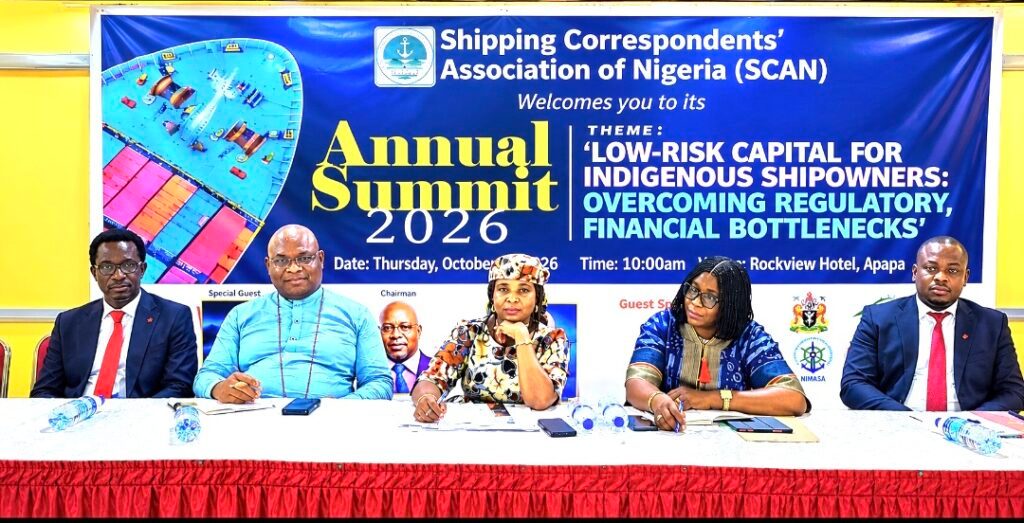
He made the call at the 2026 Annual Summit of the Shipping Correspondents Association of Nigeria (SCAN), held at Rockview Hotel, Apapa, Lagos. The summit was themed, “Low-Risk Capital for Indigenous Shipowners: Overcoming Regulatory and Financial Bottlenecks.”
The CVFF, established under the Coastal and Inland Shipping (Cabotage) Act of 2003, was designed to provide financial support for Nigerian shipowners to acquire vessels and strengthen indigenous participation in the country’s shipping industry.
However, disbursement of the fund has remained stalled for more than two decades.
The development has continued to attract concern among industry stakeholders, particularly as indigenous shipowners struggle to compete with foreign operators who have access to cheaper financing and more favourable lending conditions.
DAILY TREND reports that the Minister of Marine and Blue Economy, Adegboyega Oyetola, recently directed NIMASA to commence the disbursement of the fund to qualified beneficiaries.
NIMASA has disclosed that out of 92 applications received for the $700 million facility, only 20 were forwarded to Primary Lending Institutions (PLIs), while just one had reached the final approval stage.
Explaining the origin of the existing CVFF guidelines, Omatseye said they were introduced to protect the fund from the kind of losses recorded under the former Ship Acquisition Fund administered by the defunct National Maritime Authority (NMA).
He said, “The regulations for the CVFF was released in 2003. And when they released the regulation, the aim of it was to protect the money. Because of what happened to the Ship Acquisition Fund. So we all remember the Ship Acquisition Fund under National Maritime Authority (NMA). Money was given out and nobody refunded it back. So there was a deliberate effort to protect this money as best as possible which led to the guidelines on the disbursement of the CVFF.”
According to him, the guidelines provided for four Primary Lending Institutions to serve as custodians of the fund, with the financing structure requiring 50 per cent of the loan to come from the CVFF, 35 per cent from the participating bank and the remaining 15 per cent as equity contribution from the shipowner.
However, he argued that the arrangement became impractical because the banks were expected to take full responsibility for any loan default, despite having only a 35 per cent financial contribution and being restricted in their assessment and selection of borrowers.
Omatseye, who admitted that he would have approached the process differently with the knowledge he now possesses, said the guidelines failed to reflect the realities of banking operations and risk management.
He said, “And the guidelines on the disbursement of the CVFF initially provided for there to be PLIs. That is Primary Lending Institutions. And those Primary Lending Institutions were supposed to be four. And they were supposed to be the custodians of the money.
“And the disbursement was based on 50% to be taken from the CVFF Fund, 35% was to be paid by the banks as part of their contribution. And then the balance 15% was an equity contribution from the shipowner.
“Now, when we got the PLIs approved at that time, I must admit that I lacked knowledge at the time when I was there. If I know what I know now, I would do things differently.
“Why do I say so? The Guidelines is functionally bad. Why? let’s just say i am giving you 100 million dollars. From that 100 million dollars, I can contribute 50. You can only take 50 from that.
“Let me put it in a different way, I’m lending Mrs Precious 100 million dollars. From the 100 million dollars I’m lending Mrs Precious. You will take 50 million from my CVFF and give to her. You, the bank, will bring 35%. And then the borrower will bring 15%.
“But, there’s a caveat. If the Mrs Precious does not pay, you, the bank, take 100% of the risk. In the meantime, I will be telling you who to give that money to.”
He further cited the Banks and Other Financial Institutions Act (BOFIA) 2020, which gives banks responsibility for conducting risk assessments on lending transactions, arguing that the CVFF guidelines contradict the statutory responsibilities of financial institutions.
According to him, banks cannot reasonably be expected to contribute 35 per cent of a loan, bear the entire credit risk and still be required to disburse funds to beneficiaries whose selection they do not control.
He said, “Now, we have what we call the Banks and Other Financial Institutions Act (BOFIA) 2020, which gives the power of risk assessments to the bank. So you cannot tell me that I am contributing 35%, but I’m taking 100% of the risk. But you are telling me I must give the money to certain persons, already in itself there is a conflict.”
Omatseye explained that the banks had raised concerns over the arrangement, insisting that they could not be expected to take full responsibility for loan defaults without being allowed to independently assess the creditworthiness of prospective borrowers.
He said, “So, the banks told me that this is the problem we are having. You cannot allow me to take the risk assessments. And then, you now want me to take 100% of the credit risk if the borrower does not pay back.”
He added that the arrangement could make participating banks prefer to keep the money in fixed deposits rather than lend to shipowners under the existing conditions.
“So it is better for me to step outside your CVFF and do my own risk assessment on that BOFIA and then lend the money. And then leave your money as fixed deposits and the collected interest rates. That is the practicality of it,” he said.
Beyond the CVFF, Omatseye called for a private-sector-driven approach to financing indigenous shipping, arguing that Nigeria must develop funding structures capable of competing with the financing arrangements available to international shipping companies.
He said the country possessed enormous maritime opportunities, including crude oil lifting, the Dangote Refinery’s requirement for about 650,000 barrels of crude oil per day, liquefied natural gas shipments and the evacuation of solid minerals, but that these opportunities must be supported by deliberate shipping and financing plans.
He explained that the National Planning Ministry and the Nigerian Content Development and Monitoring Board receive multi-year operational plans from International Oil Companies, detailing the marine components of their activities.
According to him, such information should be made available to Nigerian shipowners and financial institutions to provide reliable data on cargo availability, vessel demand and future operational requirements.
He maintained that access to bankable data would enable financial institutions to develop appropriate funding models for indigenous operators and give lenders greater confidence in the commercial viability of vessel acquisition.
Omatseye also questioned the ability of Nigerian banks to finance shipping competitively, citing the high cost of local borrowing compared with international financing.
He explained that an LNG tanker could cost about $250 million, while Nigerian lending rates of approximately 25 per cent made it difficult for local shipowners to compete with foreign operators who could access financing at rates as low as two per cent.
He said foreign shipping companies could obtain up to 85 per cent financing at relatively low interest rates, acquire vessels and deploy them into the Nigerian market, thereby enjoying a significant cost advantage over indigenous operators facing high interest rates and stringent collateral requirements.
Delivering the keynote address, Senior Advocate of Nigeria, Dr. Olisa Agbakoba, said Nigeria did not necessarily have to rely on government funds to finance every vessel, but should instead develop a system capable of attracting private capital into the maritime sector.
Agbakoba argued that reliable cargo commitments, enforceable shipping contracts and regulatory certainty were essential to making indigenous shipping commercially viable and attractive to investors and lenders.
He called for effective implementation of the Cabotage Act, stronger coordination among maritime regulatory institutions and financing arrangements that combine commercial bank lending, private investment and development finance.
The maritime lawyer proposed six priority actions for strengthening indigenous shipping, including cargo-backed vessel financing, improved access to cargo for qualified Nigerian shipowners, clearer regulatory procedures, increased private-sector investment, stronger domestic maritime capacity and a coordinated implementation framework with measurable targets.
Meanwhile, the Minister of Marine and Blue Economy, Adegboyega Oyetola, reaffirmed the Federal Government’s commitment to accelerating the disbursement of the CVFF to qualified indigenous shipowners.
Oyetola, who was represented by the Ministry’s Director of Press, Anastasia Ogbonna, said he had directed NIMASA to commence the disbursement process to eligible beneficiaries.
He said the administration of President Bola Ahmed Tinubu was committed to building a competitive maritime sector that would enable Nigerian entrepreneurs to participate meaningfully in domestic and international shipping.
According to the minister, access to long-term financing at commercially sustainable rates remained a major challenge for indigenous shipowners because vessel acquisition required substantial capital, while high borrowing costs, collateral requirements and lengthy repayment periods placed local operators at a disadvantage.
He said the government had taken concrete steps to operationalise the CVFF, established under the Coastal and Inland Shipping (Cabotage) Act of 2003 to support indigenous vessel ownership.
Oyetola disclosed that a dedicated application portal was launched in January 2026 to promote transparency, accessibility and efficiency in the application process, while the number of approved Primary Lending Institutions was increased from five to 12.
He added that NIMASA had been directed to work closely with the approved lending institutions to accelerate the assessment of applications and disbursement to qualified beneficiaries.
The minister, however, stressed that the fund must be administered with transparency, rigorous due diligence and prudent risk management, describing it as a revolving facility whose sustainability depended on responsible borrowing, repayment and accountability.
“Our commitment to the effective implementation of the Cabotage Act remains equally firm. We recognise that protecting the legitimate participation of Nigerians in domestic shipping must go hand in hand with building their financial, technical and operational capacity,” he said.
Oyetola also urged financial institutions to develop financing products suited to the commercial realities of the maritime industry and called on shipowners to embrace sound corporate governance, proper financial reporting and disciplined repayment practices.
He said reducing investment risks required more than making funds available, stressing the importance of a predictable regulatory environment, credible business plans, transparent financing arrangements, effective insurance and reliable revenue streams.
Beyond the CVFF, the minister said the Federal Government was pursuing broader initiatives to strengthen indigenous participation in shipping, improve maritime safety, develop Nigerian seafarers and expand services supporting vessel ownership and operations.
He also disclosed that the government was exploring a commercially driven national shipping line initiative based on private capital, professional management, strategic partnerships and international expertise.
According to him, the proposed initiative would complement indigenous operators, expand Nigeria’s shipping capacity and operate on a sustainable commercial basis.
Oyetola said the broader objective was to encourage greater Nigerian ownership of vessels capable of serving domestic trade and competing in international shipping, while creating more opportunities for Nigerian seafarers to gain sea-time experience and secure employment.
He called for stronger collaboration among government, shipowners, financiers, regulators and industry professionals to remove regulatory and financial bottlenecks, strengthen indigenous shipping and ensure that Nigerians secure a greater share of opportunities in the maritime economy.
One of the approved Primary Lending Institutions, United Bank for Africa (UBA) Plc, also reaffirmed its commitment to promoting indigenous shipowners through innovative and de-risked financing structures, trade facilitation and advisory services.
UBA’s Regional Manager 2, Apapa, Nelson Edoye, gave the assurance while delivering a goodwill message on behalf of the Group Managing Director, Oliver Alawuba, at the summit.
Edoye said UBA recognised the capital-intensive nature of shipping and the need for financing models that would reduce investment risks and improve access to affordable capital for Nigerian operators.
He said, “At UBA, with our presence in 20 African countries and global operations, we understand the capital-intensive nature of shipping and the need for innovative, de-risked financing structures.”
He noted that indigenous shipowners faced challenges arising from limited access to patient capital and regulatory complexities, adding that addressing the problems required collaboration among banks, regulators and other industry stakeholders.
In his welcome address, President of SCAN, Moses Ebosele, said indigenous shipping remained central to Nigeria’s economic growth, employment generation, technology transfer and foreign exchange earnings, but continued to face obstacles limiting its competitiveness against foreign operators.
Ebosele identified high borrowing costs, stringent lending conditions, multiple charges, administrative delays, policy inconsistency, inadequate ship-repair and dry-docking infrastructure, limited cargo access, maritime insecurity and a shortage of skilled seafarers as major constraints confronting indigenous operators.
He said, “Ship acquisition requires substantial capital investment, while the high cost of borrowing and stringent lending conditions make it difficult for many Nigerian operators to acquire vessels or expand their fleets.”
He urged the Federal Government, development finance institutions, commercial banks and other financial partners to create accessible, long-term funding arrangements that reflect the capital-intensive nature of shipping.
The SCAN president also called for effective management of the CVFF, simplification of regulatory procedures, harmonisation of charges, stronger enforcement of local-content policies and strategic partnerships between Nigerian operators and international shipping companies.
He further stressed the need for investment in maritime education, seafarer training, port infrastructure and waterways security, as well as closer collaboration between the public and private sectors.
“Indigenous shipping must be recognised as a strategic national economic asset rather than merely a private commercial undertaking,” Ebosele said, adding that the summit should produce clear and implementable recommendations for government and relevant authorities.