IMION DG Unveils Roadmap to Save Nigeria’s Collapsing Fisheries

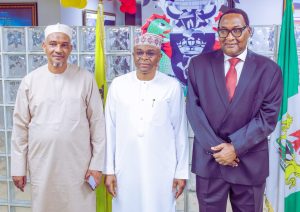
Director General of IMION, Rear Admiral Thaddeus Christopher Udofia

The Director-General of the International Maritime Institute of Nigeria (IMION), Rear Admiral Thaddeus Christopher Udofia, has outlined a five-pillar strategic framework to reverse the decline of Nigeria’s fisheries, protect coastal livelihoods and address national food insecurity.
Udofia presented the roadmap in a keynote address at the Maritime Correspondents’ Organisation of Nigeria (MARCON) National Conference at the Rockview Hotel, Apapa, Lagos.
The conference was held under the theme “Sustainable Fishing in Nigeria—Pathways to Growth, Food Security and Coastal Livelihoods.”
Warning of the state of the country’s marine resources, he called for a shift from vulnerability to disciplined execution.
“Let me be clear regarding sustainability: we cannot expect to harvest tomorrow what we ruthlessly destroy, allow others to destroy, or neglect to nurture today,” Udofia stated. “To transition from vulnerability to long-term sustainability and food security, Nigeria must boldly chart a new course defined by disciplined execution and measurable performance indicators.”
The first pillar of the framework is unified regulatory enforcement. Udofia said Nigeria should harmonise the competencies of maritime security agencies, port economic regulators and fisheries departments.
He said the Nigerian Navy’s successes in suppressing piracy and combating Illegal, Unreported and Unregulated (IUU) fishing should be systematically extended across the entire domestic fisheries sector.
The second pillar is data-driven maritime policy.
According to the IMION boss, marine management cannot be driven by guesswork, and the Federal Government should empower research institutions, including the Nigerian Institute for Oceanography and Marine Research (NIOMR) and IMION, to generate empirical data on fish stock assessments.
He added that national policies on catch limits, closed seasons and marine protected areas must be anchored on credible scientific evidence and strictly enforced.
On the third pillar, a transition to aquaculture, Udofia urged the country to move from unpredictable wild-capture fisheries to technology-driven fish farming. He said modern cage culture systems in coastal lagoons could help close Nigeria’s national food deficit.
He also called for investment in cold-chain infrastructure, processing technology and institutional training to cut post-harvest losses, and to turn fishing from a speculative survival trade into a wealth-generating enterprise for women and youth.
The fourth pillar is advanced intelligence monitoring. Udofia said effective management requires accurate measurement, and IMION advocates data-driven marine spatial planning backed by robust Blue Economy knowledge systems.
He called for the immediate deployment of Vessel Monitoring Systems (VMS) and satellite surveillance, alongside stricter enforcement of catch quotas, so that industrial fishing fleets leave enough room for marine stocks and coastal communities to regenerate.
The fifth pillar is community-led co-management. Udofia argued that top-down enforcement alone cannot deliver sustainable fishing, noting that the heart of the Blue Economy lies with the millions of coastal dwellers who have lived alongside the sea for generations.
He said the Government should institutionalise Community-Based Fisheries Management (CBFM) by empowering local cooperative societies and granting them legitimate co-management rights. When communities hold a legal, vested stake in their marine environment, he said, they naturally become the frontline defence against destructive practices.