Minister Oyetola Woos Litoral State Governors on Domestication of Marine, Blue Economy Policy

—As Ondo Gov Says ‘We dont Have Enough Support from Your Ministry’
By DAPO OLAWUNI
There are strong indications that the National Policy on Marine and Blue Economy developed by the Federal Government has enjoyed limited acceptance, even as the Minister of Marine and Blue Economy, Adegboyega Oyetola has called on State Governors of litoral states to domesticate the policy which was developed last year.
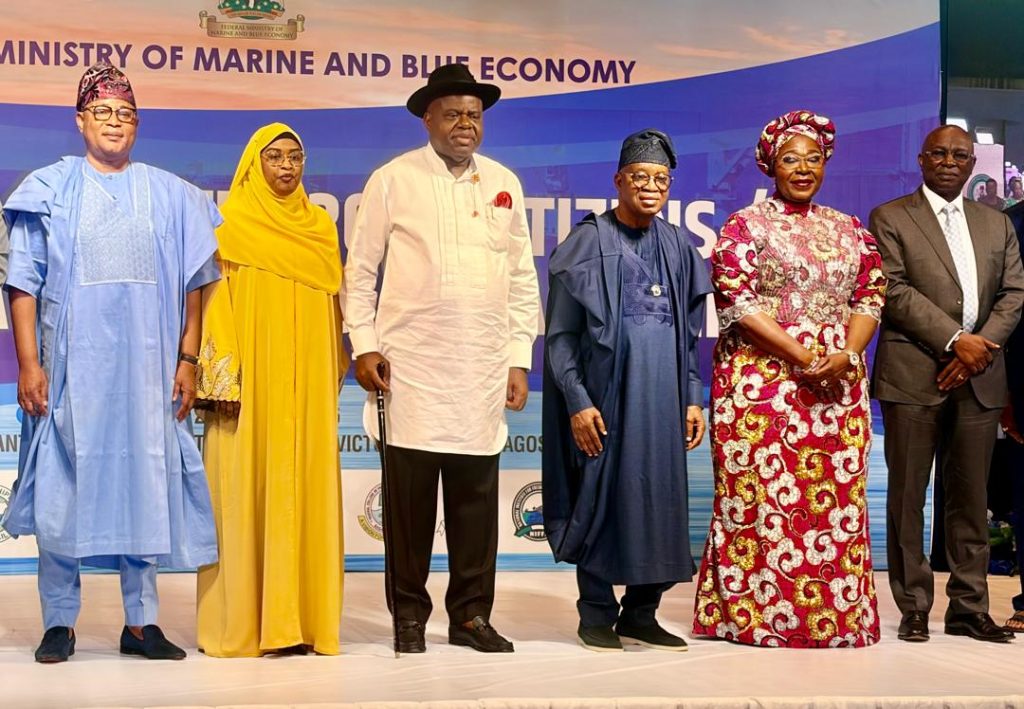
Oyetola made the call at the 2nd Quater 2026 Citizens and Stakeholders Engagement with the theme; Mobilising Subnational Governments for Effective Implementation of Nigeria’s National Policy on Marine and Blue Economy.
Speaking, the Minister said that policies derive their true value not just from formulation but from their faithful implementation.
Meanwhile, the Governor of Ondo State, Lucky Aiyedatiwa has lamented that the Blue Economy ministry has not given needed support to litoral states in the implementation of the policy.
Represented by his Assistant on Marine and Blue Economy, Eng Olu Aladenusi, Governor Aiyedatiwa said “I want the minister to know that all the litoral states that are supposed to be implementing the policy don’t have enough push and support from the federal ministry of marine and blue economy”
“We have been trying to domesticate this policy in Ondo state, but where is the way forward?
There are a lot of openings now at the federal ministry of marine and blue economy, we have the fishery department coming to the marine and blue economy. At the state levels, everything is open, the people that are from the agric department or the fishery of agric department, they are refusing to come out, and asking for the document.
Where is the document from the federal ministry that gave this permission? Several times I have called my sister from NMASA, how did you advance your side?
“You have to domesticate this policy at the state level, then the instrument, the push from the federal ministry for us to do this is not in place” he said
Minister Oyetola in his speech argued that implementation of the Policy should not rest solely on the shoulders of the federal government.
According to him, It requires strong partnership among the federal government, state governments, local communities, private sector, development partners, and citizens.
“This is why today’s conversation, in particular, is of particular importance. The policy will achieve its full promise only when every tier of government embraces it as a shared development agenda and aligns its programs, investments, and institutional priorities accordingly”
“Many of the assets that define the blue economy are located within our states and communities. Our rivers, creeks, coastlines, inland waterways, fisheries, tourism corridors, and maritime support industries offer enormous opportunities for wealth creation, employment generation, food security, and environmental sustainability.
“State governments, therefore, are in strategic positions in translating national aspirations into practical initiatives that directly impact the lives of our people” he said
Speaking further, the Minister said the safety of Nigerians using the inland waterways remains a matter of utmost concern to the federal government. He disclosed that the ministry has continued to work closely with relevant agencies and state governments to strengthen safety awareness, improve enforcement, and promote safer navigation.
“One of the flagship interventions has been the nationwide distribution of life jackets to riverine and coastal states. This initiative is already helping to build a stronger culture of safety across our waterways while protecting countless lives.
“However, the federal government’s interventions alone cannot eliminate risks on our waterways. Therefore, I wish to once again appeal to our state governments to intensify their collaboration with our ministry in addressing this challenge.
“In particular, I urge the states to phase out the use of unsafe wooden passenger boats and replace them with modern fiber boats, which offer greater durability, stability, and safety.
“I therefore call on our coastal states to develop implementation frameworks that align with the national policy on the marine and blue economy, integrate its economic priorities into their development plans, encourage responsible private investment, strengthen environmental stewardship, and build institutional capacity for sustainable resource management.
“To the private sector, I say that this is your moment. Government is creating an enabling environment for investment, innovation, and enterprise. We welcome partnerships that will unlock capital, deploy technology, create jobs, and accelerate the growth of the Nigerian blue economy.
“history teaches us that transformational policies succeed only when they are embraced by all stakeholders. The National Policy on Marine and Blue Economy has rightly been acclaimed as a bold and visionary framework for harnessing Nigeria’s vast aquatic endowment.
“Its sustainable implementation, however, depends on robust collaboration between the federal government, state governments, and the private sector. No single institution can accomplish this task alone” he concluded
While also delivering their goodwill messages, the Governor of Akwa Ibom State, Pastor Umo Eno who was represented by his Deputy, Senator (Dr) Akon Eyakenyi, as well as Governor of Borno State, Dr Abdulkareem Babagana assured that their States are on the verge of recreating the Ministry of Marine and Blue Economy at state level.
Delivering the keynote address, Bayelsa State Governor, Senator Duoye Diri, said Bayelsa has created its own Ministry of Marine and Blue Economy in June 2024 to drive the blue economy component of the state’s prosperity Agenda.
Diri said the state ministry had commenced major fish production at the Bayelsa Aquaculture Village in Yenegwe, where an operational hatchery was breeding high-quality catfish fingerlings and juveniles to boost food security and create jobs. He added that the state had expanded its marine transport fleet and was aggressively pursuing the development of the proposed Agge Deep Seaport as the next maritime gateway for the Niger Delta.
The governor also proposed five key pathways for coastal states to maximise opportunities in the blue economy: establishing dedicated ministries of marine and blue economy, enacting enabling legislation, properly mapping and securing their maritime domains, investing in credible data collection and analysis, and developing skills, markets, innovation hubs and logistics infrastructure.
In his presentation on private sector investment and industrialisation, President and Chief Executive of Dangote Industries Limited, Aliko Dangote, said the successful implementation of the National Policy on Marine and Blue Economy would depend largely on sustained private sector participation.
Dangote, who was represented by the Managing Director of Dangote Port Operations, Simeon Akin Omole, said industrial transformation required policy consistency, quality infrastructure, access to finance and investor confidence. He identified infrastructure-led industrialisation, value-chain development and stronger public-private partnerships as the three pillars needed to unlock the sector’s enormous potential.
He said the Federal Government’s approvals for major deep seaport projects in various parts of the country would stimulate industrial clusters incorporating agro-processing, petrochemicals, shipbuilding, cold-chain logistics and maritime technology, while also boosting Nigeria’s competitiveness.