
At WISTA Africa Regional Conference, Oyetola, NIMASA DG, Others Tip Women to Drive Africa’s US$300bn Blue Economy
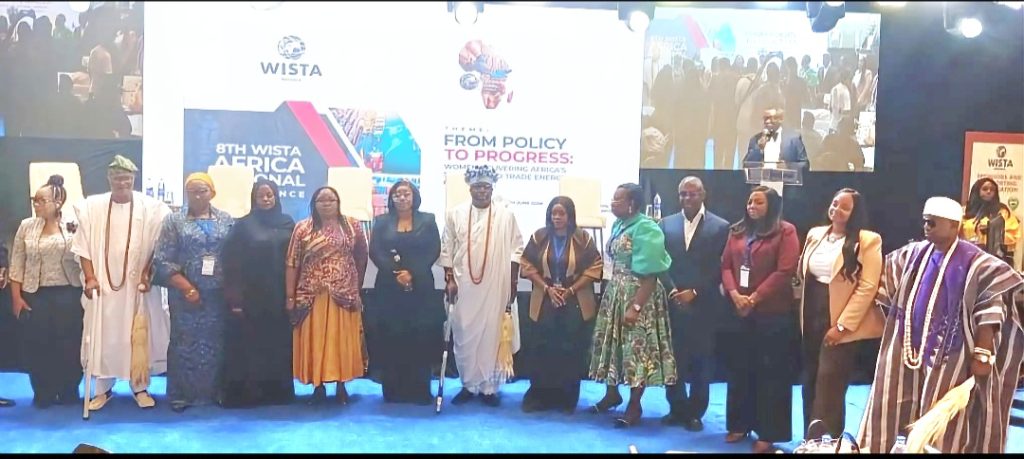
Group photograph of stakeholders and royal fathers who graced the Day-1 of the 8th WISTA Africa Regional Conference held at Eko Hotel, Lagos on Thursday

By DAPO OLAWUNI
The Federal Minister of Marine and Blue Economy, Adegboyega Oyetola, the Director General of the Nigerian Maritime Administration and Safety Agency, NIMASA, Dr. Dayo Mobereola, and other top maritime stakeholders have identified women as indispensable drivers of Africa’s blue economy, estimated to be worth over $300 billion annually, urging deliberate action to move the continent from policy commitments to measurable maritime outcomes.

They spoke at the 8th WISTA Africa Regional Conference held on Thursday at the Eko Hotel and Suites, Lagos, organised by WISTA Nigeria under the theme: From Policy to Implementation: Women Advancing Africa’s Blue Economy through Sustainable Shipping, Trade and Energy Innovation.
The two-day conference, which runs from June 25 to 26, drew government officials, maritime administrators, industry leaders, and professionals from across Africa and beyond.
Oyetola, represented by the Director of Planning, Research and Statistics at the Federal Ministry of Marine and Blue Economy, Hajia Kaltum Ibrahim, reaffirmed the government’s commitment to advancing the role of women as indispensable partners in the growth of Nigeria and Africa’s marine and blue economy, noting that the ministry had developed a comprehensive national policy on marine and blue economy to provide a strategic framework for the sustainable development of the sector.
He identified strategic public-private partnerships as a central catalyst for investment, innovation, and infrastructure development across the maritime ecosystem, while stressing that sustainable growth cannot be driven by capital alone.
“It must also be driven by people, the true measure of our ambitions does not align in the quality of our policies alone, but in our collective ability to translate both policies into tangible outcomes that improve lives, create jobs, stimulate investments, and strengthen our economies” he said.
The Minister also reaffirmed the government’s commitment to expanding access to opportunities for women and youth across the entire maritime value chain.
He described the active participation of women in the blue economy not merely as a matter of dignity, but as a strategic economic imperative, and challenged delegates to move beyond dialogue when the conference concludes.
In his goodwill message, NIMASA’s Mobereola commended WISTA Africa for its contributions to advancing women in the maritime industry through advocacy, mentorship, capacity development, and professional networking, while pointing to the scale of opportunity that makes inclusion not optional but essential.
He noted that Africa’s blue economy is estimated to be worth over $300 billion annually, with the continent’s maritime sector handling approximately 90 per cent of its international trade by volume, spanning opportunities in shipping, port operations, fisheries, aquaculture, renewable energy, marine technology, coastal tourism, and maritime logistics.
Against that backdrop, he cited sobering statistics, saying that women account for only about 29 per cent of the global maritime workforce and less than two per cent of the world’s seafarers.
Mobereola stressed that African women remain underrepresented in key maritime professions despite their growing contributions as seafarers, marine engineers, shipowners, lawyers, entrepreneurs, researchers, and policymakers.
“Policies alone are not enough. The challenge before us is implementation. We must invest in human capital, strengthen institutions, embrace innovation, and create enabling environments that promote inclusion and equal opportunities for women and young professionals” he said
He pledged NIMASA’s continued partnership with WISTA in promoting gender inclusion, professional excellence, and sustainable maritime development.
The keynote address was delivered by Dr. Dakuku Peterside, former Director General of NIMASA, who drew a sharp and unsparing distinction between what Africa signs and what Africa actually builds.
Speaking from his experience as chairman of the Association of African Maritime Regulations, Dr. Peterside argued that the continent’s fundamental problem is not the absence of policy but the absence of execution, citing the Maritime Transport Charter, the African Economic Partnership, and the African Continental Free Trade Area Agreement as instruments that exist on paper but have not been adequately translated into port efficiency, fleet development, or tangible trade outcomes.
He drew a stark contrast between the two-day vessel turnaround time at Morocco’s port and Nigeria’s ports which according to him is minimum of seven days, warning that such inefficiency is ultimately paid for by ordinary consumers.
Dr Peterside described the global net zero transition not as a burden for Africa but as an opportunity to attract green finance, build shipyards, develop regional logistics corridors, and modernise ports, provided the continent is deliberate about seizing it.
“A signature is not a shipyard. A convention is not capacity. A policy document is not a fleet. If we sign without building, we become spectators to the global maritime industry” he warned
He called on African governments to move from policy creation to implementation audits, and on every maritime authority , from South Africa’s SAMSA to the Ghana Maritime Authority to publish measurable efficiency reports.
The Deputy Speaker of the Lagos State House of Assembly, Rt. Hon. Mojisola Lasbat Meranda in her goodwill message to delegates, said that Africa’s economic future cannot be fully realised without the leadership, innovation, and participation of women.
She cited the 2024 IMO-WISTA Women in Maritime Survey, which shows that women account for less than 19 per cent of the global maritime workforce and only one per cent of seafarers worldwide, even as over 176,000 women now work across the sector and women occupy 34 per cent of board positions in surveyed maritime organisations.
“The challenge before us is not one of potential, but of implementation,” she said, urging a decisive shift from conversations about gender inclusion to deliberate actions that equip women to lead ports, shape trade policy, drive energy innovation, and command vessels across the maritime value chain.
In her welcome address, WISTA Nigeria President, Dr. Odunayo Ani, situated the conference within a broader continental ambition, recalling that 32 years ago WISTA Nigeria became the first national WISTA association established in Africa, growing from a vision by pioneering women into one of the continent’s most influential maritime professional associations.
She acknowledged the significance of Nigeria’s current maritime moment, pointing to the establishment of the Federal Ministry of Marine and Blue Economy as a strategic commitment to unlocking the potential of the country’s marine resources.
She told delegates that women in the sector are no longer only seeking a place at the table.
“We are helping to design the table, shape policies, drive innovation, lead institutions and create opportunities for future generations”
“History will not remember us only for the policies we discussed, but for the opportunities we created, the barriers we removed and the industries we transformed” she said.