Foreign Interests Killing Indigenous Barge Operations at Apapa Port, BOAN Tells Tinubu

Hon Bunmi Olumekun

Indigenous barge operators in Nigeria have raised serious concerns over what they describe as a deliberate attempt to edge them out of operations at Apapa Port, accusing terminal operator APM Terminals of restricting access to berthing space and creating an uneven business environment.
The operators, under the umbrella of the Barge Operators Association of Nigeria (BOAN), have called on President Bola Ahmed Tinubu and the Minister of Marine and Blue Economy, Dr. Adegboyega Oyetola, to urgently intervene before the situation worsens and threatens the viability of barge operations in the country’s busiest port.
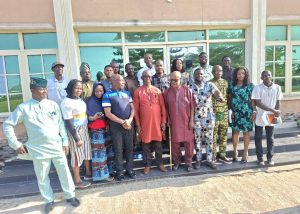
Speaking on behalf of the association, BOAN President, Hon. Olubunmi Olumekun, posited that indigenous operators are being systematically denied berthing windows, leaving them unable to load or discharge containers.
He claimed that the situation has already forced many operators to scale down activities while others are close to shutting down entirely.
Olumekun said the operators initially sought alternative arrangements by using Eko Support Terminal as a drop-off point for containers before trucking them into APMT. However, he lamented that this option has now been blocked.
According to him, the terminal operator has strengthened its control by partnering with a barge company and allowing only its preferred barges to operate at the berth. This, he argued, has effectively shut out other indigenous operators and undermined local participation in the maritime sector.
He warned that the development not only affects operators but also threatening efforts to reduce congestion on Apapa roads as barging has long been promoted as a safer and more efficient alternative to road transportation of containers, especially in Lagos where port traffic has repeatedly paralysed surrounding communities.
Olumekun also raised concerns over the common user finger jetty in Apapa, which he said was originally reserved by the Federal Government for general use. He asserted that the facility has now been taken over in practice, preventing independent operators from accessing it despite repeated appeals to relevant authorities.
Beyond the issue of berthing space, the BOAN President stated that a sharp increase in terminal handling charges has made barge transportation almost impossible to sustain. He disclosed that charges that previously stood at about N50,000 have risen to nearly N300,000, pushing the cost of moving containers by barge far above the cost of road transport.
He explained that transporting a 40-foot container by truck from Apapa to Oshodi now costs roughly N250,000, while barge operators are forced to charge between N700,000 and N800,000 due to rising terminal fees, fuel costs, labour and other operational expenses.
“With this kind of cost structure, how can we compete and how can the government expect barging to help decongest the roads?” he asked.
Olumekun further argued that the situation contradicts the Federal Government’s push to strengthen indigenous participation in the maritime sector and develop the blue economy. He warned that excluding local barge operators from the port would ultimately affect cargo movement efficiency and increase the cost of goods nationwide.
According to him, the association has written several letters to government agencies and plans to escalate the matter further if urgent steps are not taken to restore fair access to port facilities.
Meanwhile, BOAN’s Director of Enforcement and Operations, Nura Wagani, said the increase in terminal charges was introduced without consultation with barge operators, describing it as a major blow to their operations.
Wagani noted that importers and freight forwarders naturally prefer the cheaper option, which is now road transportation. He warned that the shift back to trucks could worsen the already difficult traffic situation around the Apapa corridor and reduce the gains made through water-based cargo evacuation.
He also pointed out that the challenge appears to be concentrated mainly at Apapa Port, noting that barge operations at Tin Can Island Port remain more affordable and accessible.
“The increase in terminal handling charges was carried out without consulting us. If a truck is loading one container for N280,000 and a barge is loading for N580,000, you would prefer to go for the cheaper one. The increment is going to affect the whole nation because anyone taking delivery by barge would add it to the cost of selling their commodities for the common man.”
Wagani also drew a sharp contrast between the situation at Apapa and that at Tin Can Island Port, noting that the crisis is largely localised to APMT’s operations.
“We as barge operators have been thrown out of business, nobody is patronising us because of these exorbitant rates. This is only happening in Apapa Port. If you go to the Tin Can Island Port, the cost is not the same, Tin Can Island is far cheaper than Apapa where APMT is flexing muscles and trying to take over our barging operation,” he said.
The operators are therefore urging the Minister of Marine and Blue Economy and other relevant authorities to urgently investigate the situation, enforce fair access to berthing space, and ensure that indigenous barge operators are not pushed out of business.
They insist that without swift intervention, the country risks losing one of the most practical solutions to port congestion while also weakening local participation in the maritime industry.