Gulf of Guinea Countries Explore Technological, Intelligence-driven Approach to Tackle IUU Fishing
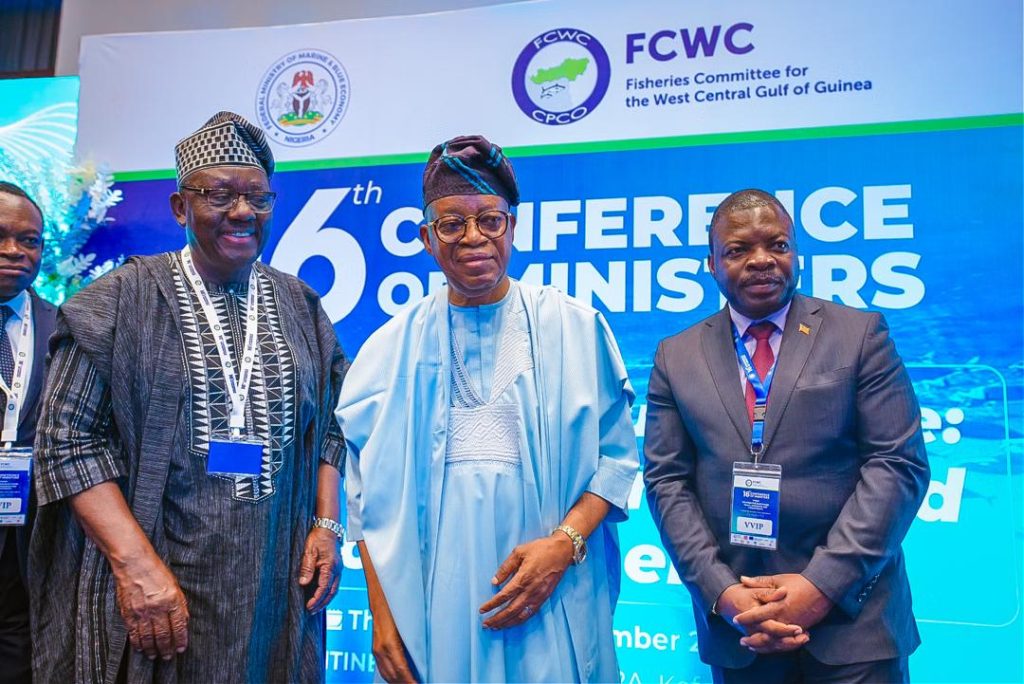
L-R: Benin Republic's Minister of Agriculture, Livestock and Fisheries, Mr Gaston Dossouhoui; Nigeria's Minister of Marine and Blue Economy, Dr Adegboyega Oyetola (CON) and former Chairman of the Conference of Ministers of the Fisheries Committee for the West Central Gulf of Guinea (FCWC), Mr Cyrus Saygbe Sr, at the 16th Conference of Ministers of the FCWC in Victoria Island, Lagos, on Thursday.
—Elects Nigeria’s Minister, Adegboyega Oyetola As Chairman
By DAPO OLAWUNI
Countries within the Gulf of Guinea including Benin, Côte d’Ivoire, Ghana, Liberia, Nigeria and Togo, under the aegis of Fisheries Committee for the West Central Gulf of Guinea (FCWC) have resolved to deploy technological, intelligence and coordinated approach towards tackling the menace of Illegal, unreported, and unregulated (IUU) fishing which is a major threat to marine sustainability and the region’s stability.
This was declared on Thursday at the 16th Conference of Ministers of the FCWC, hosted by Nigeria at the Lagos Continental Hotel, Victoria Island, Lagos.
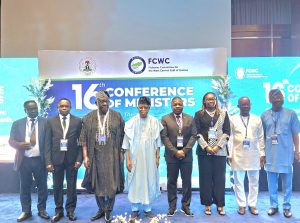
The committee have also elected Nigeria’s Minister of Marine and Blue Economy, Dr Adegboyega Oyetola as its Chairman.
Oyetola took over from Hon Cyrus Saygbe who is the Director General, National Fisheries and Aquaculture Authority, Republic of Liberia.
In his acceptance speech, Dr Oyetola expressed deep gratitude for the confidence reposed in him by his colleagues and pledged to build on the strong foundation laid by his predecessors. He underscored his commitment to advancing collective action against illegal, unreported, and unregulated (IUU) fishing — a major threat to marine sustainability and regional stability.

“Together, we must put an end to the scourge of illegal, unreported and unregulated fishing in our waters,” Oyetola declared.
“This menace robs our nations of economic opportunities, threatens our food security, and undermines the livelihoods of millions who depend on the sea. Under my chairmanship, I will work collaboratively with all Member States to ensure stronger enforcement, better data sharing, and improved governance of our shared marine resources.”
The Minister emphasised that his tenure would prioritise regional cooperation, transparency, and capacity building as tools to strengthen the collective management of ocean resources within the West Central Gulf of Guinea.
He noted that effective ocean governance is a shared responsibility that demands political will, coordinated enforcement, and sustained partnerships across borders.
Earlier in his keynote address to the Conference, Dr Oyetola had welcomed delegates on behalf of President Bola Ahmed Tinubu, , and the Government and people of the Federal Republic of Nigeria. He reaffirmed Nigeria’s strong commitment to the FCWC and highlighted the growing importance of the blue economy in national development.
“Our sub-region is richly endowed with marine resources that support livelihoods, food security, trade, and cultural identity for millions of our people,” he said. “Yet these resources face growing pressures from IUU fishing, maritime insecurity, pollution, and the far-reaching impacts of climate change. These are challenges that no nation can overcome in isolation; they demand sustained regional collaboration, political will, and shared responsibility.”
Dr Oyetola noted that the Tinubu administration views the marine and blue economy as a strategic frontier for economic diversification and transformation.
He outlined Nigeria’s ongoing reforms in port modernisation, maritime security, aquaculture expansion, and institutional coordination aimed at fostering sustainable growth.
He further called for strengthened joint patrols, harmonised regulations, real-time intelligence sharing, and coordinated enforcement mechanisms among FCWC Member States.
“At the regional level, cooperation remains our greatest strength,” he observed.
In his speech, the outgone chairman of the committee, Hon Cyrus Saygbe revealed that the region is moving decisively from policy to practice with arrangements finalized for a joint maritime patrol exercise between Liberia, Nigeria, Cote d’Ivoire coordinated through the FCWC’s Regional Monitoring Control and Surveillance Center.
“This is regional solidarity in action protecting our shared waters, our and our collective future. The challenge before us is illegal fishing.
Illegal, unreported and unregulated fishing continues to rob our region of billions of dollars every year.
“Resources that could have built schools, funded hospitals and created jobs for our youth. Beyond the numbers, IUU fishing threatens the very fabric of our coastal communities. It undermines food security, weakens state authority and erodes the trust of our fisher folks.
“Moreover, the nature of IUU activity is becoming interestingly sophisticated with vessel identity fraud, mobile transshipments and the use of advanced technology to evade detection. Our response, therefore, must be equally technological, intelligence-driven and coordinated” he said
Hon Saygbe reiterated that Countries of the Gulf of Guinea waters must embrace the tools of modern fisheries management including digital vessel tracking systems, electronic cash document, satellite-enabled surveillance and real-time monitoring platforms.
These are no longer optional luxuries. They are essential instruments for sustainable governance.
I urge all of us to commit to expanding real-time vessel monitoring systems and adapting automated anomaly detection tools.
Establishing interoperable electronic cash documentation and e-listening systems across all member states. Scaling up data sharing and analytical collaboration through joint enforcement actions coordinated by the regional centre.
“We must also strengthen posted measures, harmonize vessel and registration databases and align sanctions and penalties so that IUU actors find no safe haven, neither at sea nor in our boats” he said