Nigerian Ports Losing N1 Trillion Annually Due to Lack of Automation, Modernization—-Experts
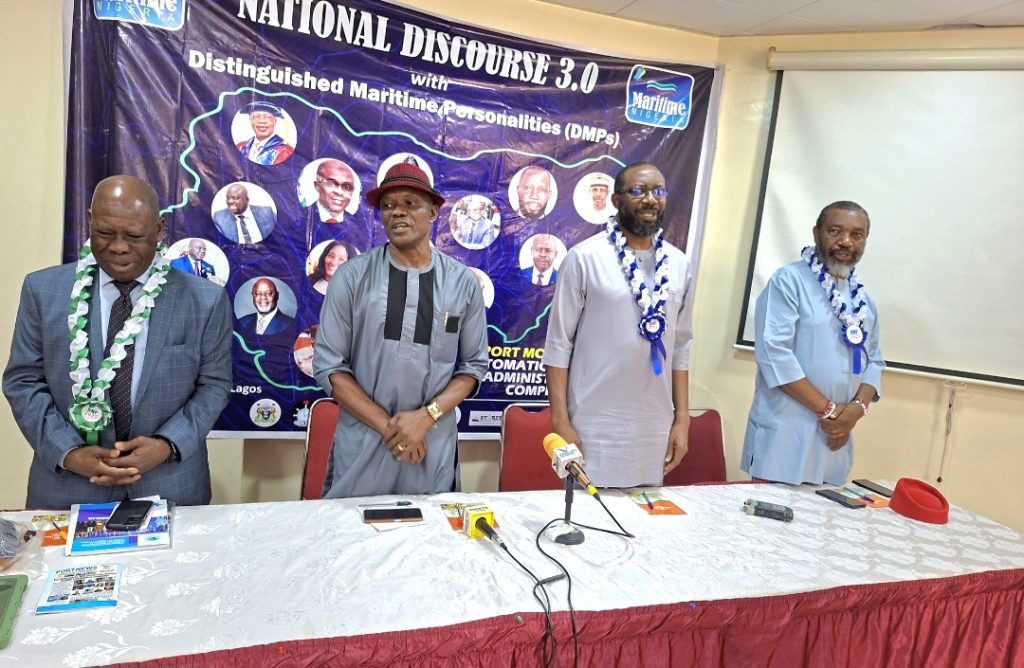
L-R: Eng Richard Owolabi, Mr Kelvin Kagbare, Capt Warredi Enisuoh and Chief Eugene Nweke at the 2025 National Discourse at Rockview Hotel in Apapa Lagos on Thursday
By DAPO OLAWUNI
Maritime experts in the Nigerian marine and Blue economy sector converged at the Rockview Hotel in Apapa, Lagos, on Thursday for the 2025 National Discourse, a flagship gathering focused on “Port Modernization: Automation, Regulation, Administration and Competencies,” where alarming figures on the cost of port inefficiency were presented.
The consensus among speakers was that the nation’s critical port infrastructure is structurally constrained, resulting in staggering economic losses estimated at over ₦1 trillion yearly.
Delivering a paper at the event convened by Maritime Nigeria, Dr. Oluwasegun Musa, Chief Consultant, Widescope International Group, identified the core problem as structural inefficiencies and logistical chaos at Apapa and Tin Can ports, which has caused cargo dwell time to often exceed 21 days, severely eroding Nigeria’s trade competitiveness.
While acknowledging that administrative interventions like the electronic call-up system (Ètò) have restored some operational discipline, Dr. Musa asserted that these measures merely manage symptoms and are insufficient for comprehensive structural modernization.

He presented a four-pillar strategy for transformation, namely; Administration, Digitalization, Automation, and Competency, while mandating the immediate establishment of an Independent Economic Regulator to enforce fair pricing and contractual adherence.
Musa, a frontline freight forwarder argued that Automation requires a dual-track strategy: full automation for greenfield projects like Lekki Deep Seaport and a phased, process-simplified semi-automation for legacy brownfield sites.
“The 2006 port concession program yielded uneven results, as initial private sector investments were undercut by pervasive regulatory gaps, political interference, and infrastructural decay.
“To transition from a bottleneck economy to a competitive maritime hub, Nigeria must adopt a synchronized, multi-pillar strategy, mirroring the transformational successes of regional leaders like Dakar, Senegal, and global players like Tanger Med, Morocco” he said
He also stressed that the National Single Window (NSW) must achieve full operational status by Q1 2026, enforced by a non-negotiable paperless mandate, and warned that without decisive government-backed technical training, the critical IT and maintenance skills gap would undermine the return on investment (ROI) for any automated system.
Supporting this view on infrastructure and planning, Captain Warredi Enisuoh, Executive Director of Operations and Technical at Tantita Security Services Nigeria Limited, cautioned that port automation requires a “very, very high level of superior thinking and superior reasoning.”
Captain Enisuoh pointed out that the legacy ports; Apapa Port and Tin Can Island Port, were built long ago, and non-port activities have since crowded the areas, necessitating massive and costly resettlement efforts which could make automation more expensive than greenfield development.
He used a powerful analogy to illustrate the interdependence of automation, noting that if traffic congestion (hold-up) occurs outside the port gate, the automated systems inside the port terminals become useless, as the port and all the robots would be “standing still.”
He concluded that while the goal is achievable, the best and easiest path forward is through greenfield development coupled with strategic private sector engagement.
Mrs. Rollens Macfoy, Managing Director of OceanDeep Services Limited and former President of WIMA-Nigeria, provided historical context and highlighted recent progress, noting that the 2006 concession shifted the Nigerian Ports Authority’s (NPA) role to that of a Landlord and Regulator.
She showcased positive signs of growth, including a 9.7% rise in container throughput in 2024 and a substantial 53.7% increase in export-laden containers.
Mrs. Macfoy confirmed that the new Lekki Deep Seaport is a major milestone and outlined the necessary modernization steps, which include rehabilitating and expanding physical infrastructure, fully adopting the Ètò system, and enhancing multimodal linkages, especially rail, for hinterland cargo transportation.
She also emphasized that the ongoing push for the Nigeria Shipping & Port Economic Regulatory Agency Bill 2023 is vital for updating regulations and improving economic oversight.
From the regulatory perspective, Engr. Richard Owolabi, representing the Secretary General of the Abuja MoU, Captain Sunday Umoren, defined ports as strategic instruments of national development.
He underscored the financial magnitude of the problem, noting that African port inefficiencies cost the continent an estimated $2.5 billion annually.
Engr. Owolabi cited World Bank data showing that digitalized ports achieve up to 65 percent faster vessel turnaround and 40 percent shorter cargo dwell time, stressing that modernization must be a holistic transformation—technological, institutional, and human.
He commended the Ministry of Marine and Blue Economy’s alignment with global standards through initiatives like the Port Community System (PCS) and the development of deep seaports, while reiterating the Abuja MoU’s commitment to regional cooperation to harmonize procedures and ensure the region meets the highest global standards.
The event, which also included the presentation of awards to Distinguished Maritime Personalities (DMP) for the year 2025, concluded with a call for unified action.
Earlier in his welcome address, Mr. Kelvin Kagbare, Managing Editor of Maritime Nigeria, Publisher of Maritime Insiders and News Gate newspaper, whose organization hosted the discourse, framed the event as an urgent quest in dire search of transformation.
Mr. Kagbare commended the efforts of the organizing committee and urged attendees to remember that “the future of Nigeria’s maritime sector depends on our collective resolve to modernize, regulate, and empower,”