IMO Secretary-General, Arsenio Domínguez Promises Support for Nigeria’s Maritime Capacity Building
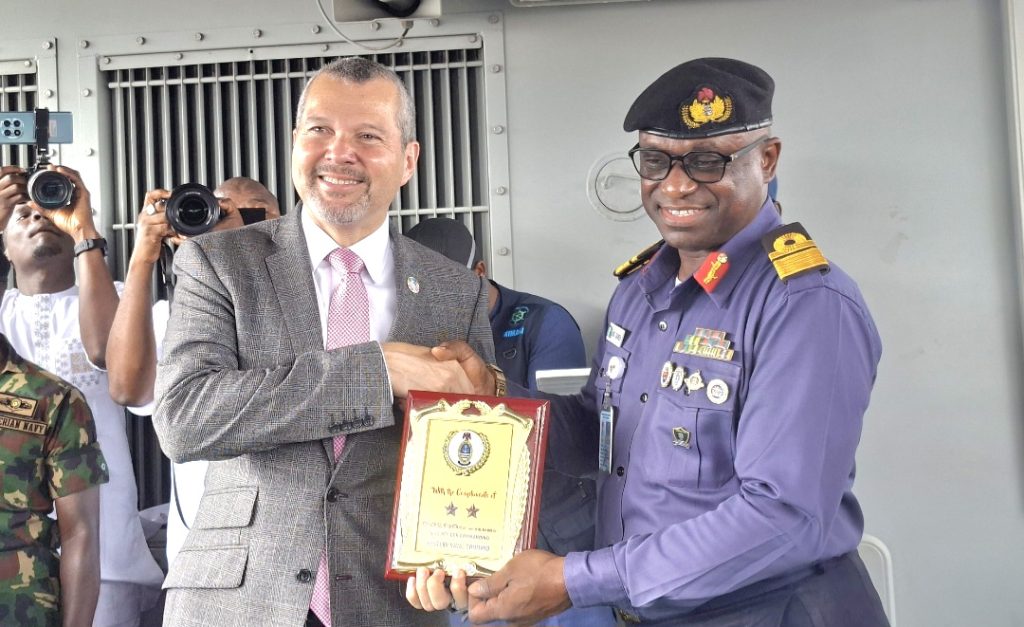
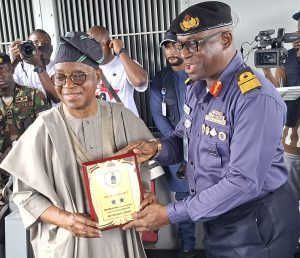
Secretary-General of the International Maritime Organization (IMO) Arsenio Domínguez (left) receiving a souvenir from the Flag Officer Commanding, Western Naval Command, Rear Admiral Gregory Oamen onboard the Naval Hydrographic vessel, NNS Lana on Friday.
—Tours NIMASA, Navy Maritime Facilities in Lagos,
The Secretary-General of the International Maritime Organization (IMO), Arsenio Domínguez, on Friday continued his official three-day working visit to Nigeria with an extensive tour of major maritime formations in Lagos, underscoring the country’s pivotal role in global maritime security and manpower development.
Domínguez, who arrived in Nigeria on Thursday, had earlier met with the Minister of Marine and Blue Economy, Adegboyega Oyetola, and heads of key maritime agencies, followed by a courtesy call on President Bola Ahmed Tinubu at his Lagos residence.
On Friday, the second day of his visit, Domínguez, in company of Minister Oyetola, visited the Nigerian Navy’s hydrographic research vessel, NNS Lana, stationed in Apapa. He was warmly received by the Flag Officer Commanding, Western Naval Command, Rear Admiral Gregory Oamen, and the Commanding Officer of NNS Lana, Captain O.S. Giwa, who briefed him on the vessel’s operations and contributions to Nigeria’s maritime domain awareness.
Commissioned in 2021, NNS Lana is a state-of-the-art hydrographic vessel designed to conduct oceanographic and charting surveys within Nigerian and international waters. The ship plays a critical role in enhancing navigational safety, supporting maritime research, and providing vital data for oil and gas exploration. Domínguez commended the Navy’s investment in modern hydrographic capability, noting that such infrastructure strengthens maritime safety and international trade.
The IMO Secretary-General also visited two critical facilities of the Nigerian Maritime Administration and Safety Agency (NIMASA) in Kirikiri, Apapa—the C4i Centre and the Regional Maritime Rescue Coordination Centre (RMRCC).

The C4i Centre, a cornerstone of Nigeria’s Deep Blue Project, integrates advanced technologies in command, control, communication, computer, and intelligence operations. It serves as a hub for maritime surveillance, intelligence gathering, and rapid response coordination. Since its establishment, the centre has significantly contributed to reducing piracy incidents in the Gulf of Guinea, fostering greater safety for international shipping.
The RMRCC coordinates Nigeria’s search and rescue operations across its maritime domain and collaborates with regional and international bodies to enhance safety at sea. Over the years, it has successfully managed rescue operations for distressed vessels and provided timely interventions that have saved countless lives and assets in Nigerian waters and beyond.
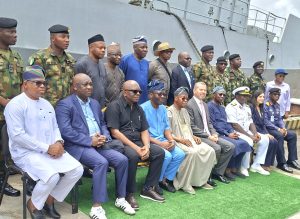
Visibly impressed by the facilities, Domínguez lauded Nigeria’s leadership in securing the Gulf of Guinea and in developing robust maritime safety frameworks. He said Nigeria’s commitment to maritime security and rescue operations is exemplary, as the facilities reflect a level of preparedness and innovation that aligns with IMO’s global mission of safe, secure, and sustainable shipping.
The IMO chief’s itinerary also included a visit to the University of Lagos Institute of Maritime Studies (IMS) where he toured facilities and interacted with students.
He promised support for the institution in area of sharing knowledge, especially on decarbonisation, e-learning courses from World Maritime University among others.
While reacting to the speech made by Deputy Vice Chancellor of the institute, Professor Bolanle Olufunmilayo Oboh, Dominguez said “You talked about decarbonization, this is another area where we have several projects within IMO, and Nigeria is part of the Green Voyage 2050 in the development of the National Action Plan that we can link immediately to the Institute. I can go on and on with areas that we can actually partner with you, that you can participate and engage in the several projects that we have in the organization.
“You can also start using the e-learning courses that we are producing and making available through the World Maritime University and some of them directly through IMO. So there are areas for us to immediately start working together” he said.
He expressed admiration for Nigeria’s investments in maritime manpower development, particularly commending NIMASA for donating a new buildingvisit to the Institute of Maritime Studies (IMS) at the University of Lagos (UNILAG), to the institute and for its continued support of capacity-building initiatives in the sector.
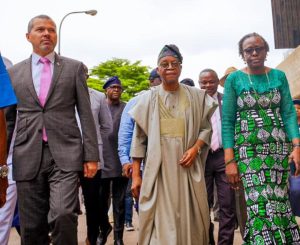
L-R: Secretary-General of the International Maritime Organization (IMO), Arsenio Domínguez; Minister of Marine and Blue Economy, Adegboyega Oyetola and Deputy Vice Chancellor (Academics and Research), University of Lagos, when the IMO Secretary-General visited the Institute of Maritime Studies at the university as part of his visit to Nigeria, on Friday.
Minister Oyetola, speaking at the event, praised UNILAG for its role in training the next generation of maritime professionals. He highlighted the government’s efforts to reposition the marine and blue economy sector as a major revenue earner beyond oil.
“The maritime sector holds immense opportunities for our youths — in career growth, entrepreneurship, and international engagement. Our goal is to build a new generation of maritime professionals who will drive Nigeria’s transformation as a global maritime hub,” Oyetola said.
As an alumnus of the university, the minister encouraged students to pursue excellence with hard work and innovation, stressing that the future of Nigeria’s economy rests on the strength of its human capital.
The Minister declared that Nigeria’s marine and blue economy sector is being strategically repositioned to serve as the country’s major revenue earner, replacing crude oil as the dominant source of national income.
He said the Federal Government is committed to unlocking these opportunities through investments in infrastructure, manpower development, and international partnerships.
“Nigeria’s future lies beyond oil. The marine and blue economy is a goldmine that can drive sustainable economic growth, create millions of jobs, and position our nation as a global maritime hub. We are determined to harness its full potential to become the primary driver of our economy,” the minister said.
“There are abundant opportunities for our young people in shipping, logistics, fisheries, shipbuilding, marine research, and offshore energy. I encourage you to be bold, innovative, and diligent. The future of this sector, and indeed the future of Nigeria’s economy, rests on your shoulders,” he added.
Domínguez and Oyetola also took time to engage directly with IMS students, offering words of counsel and encouragement.