4% FOB Levy: Customs CG, Adeniyi Meets Manufacturers, Dangles Big Carrots

Bashir Adewale Adeniyi, Customs Comptroller-General
—On-Stop-Shop Creation, B’Odogwu Integration to National Single Window, Checkpoints Removal
By DAPO OLAWUNI
Following the recent suspension of the Nigeria Customs Service’s 4% FOB Levy collection by the Ministry of Finance at the instance of petitions written by the Association, the Comptroller-General of Nigeria Customs Service, Bashir Adewale Adeniyi on Friday met with the Manufacturers Association of Nigeria (MAN) in order to form strategic partnerships and ways to forget ahead.
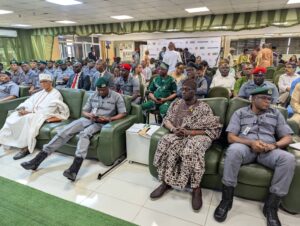
At the townhall meeting held at MAN office in Ikeja Lagos, Adeniyi said the service has created a one stop shop platform for manufacturers to interact with the service and other government agencies, so as to eliminate delays in taking delivery of their cargoes.
Adeniyi also said that the service has began the process of integrating its indigenous trade platform, Bodogwu, into the National Single Window platform which is billed to commence in 2026.
“I am indeed delighted to address you today as partners and key stakeholders in Nigeria’s economy.
The manufacturing sector is the backbone of our industrial development and the success of that sector directly connects to our nation’s prosperity.

“Recent developments, particularly that of the Ministry of Finance directive regarding the suspension of the 4% FOB charge have opened pathways for deeper dialogue between our institutions.
“While this charge exists as a legal provision under the Nigeria Customs Service Act 2023, effective implementation requires genuine consultations like the ones we’re having today with those that it impacts most directly.
“This process of consultation, therefore, balances fiscal responsibilities with industrial growth imperatives. Your voices matter, all our manufacturers, and your experience helped to shape our understanding of how customs procedures can either enable or constrain manufacturing excellence.
“The Nigeria Customs Service has consistently supported manufacturing through concrete initiatives that recognize the strategic importance of industrial competitiveness to our national economic objectives.
“Our support extends to structural trade facilitation improvements. Just a couple of days ago, we concluded the process of developing a comprehensive framework for establishing one-stop shops that will revolutionize how manufacturers interact with customs and other regulatory agencies.
“This initiative aims to eliminate bureaucratic processes that frustrate legitimate business operations as we continue to maintain robust security and compliance standards.
“We have also carried out systematic streamlining of checkpoints along our major highways, reducing unnecessary delays that add costs without adding value to revenue generation or our security outcomes. Digital transformations lies at the heart of our trade facilitation strategies.
“We have investments in systems like the Bodogu platform that provide real-time clearance capabilities, automated risk assessments, and seamless integration with the supply chain system.
“Technology should eliminate friction in the supply chain. All of these technology initiatives complement our policy frameworks to create comprehensive support for manufacturing sector growth.
“As we speak here, distinguished ladies and gentlemen, we have commenced the integration of our Bodogu system into the National Single Window Project, which is expected to come upstream in the first quarter of 2026.
“Our engagements today have reinforced that the Nigerian Customs Service and the manufacturing sector share fundamental objectives to support economic growth, job creation, industrial competitiveness, and national prosperity.
“Our role is to facilitate legitimate trade, as well as to continue to protect our borders and collect appropriate revenues, while your role is to drive industrial production, create employment, and contribute to our nation’s economic diversification.
“These roles are complementary, and they require this kind of collaboration that we are having to achieve optimal outcomes.
So the discussions that we have lined up today show that structured dialogue produces better outcomes than isolated policy developments.
“We have identified specific areas where customs procedures can be refined to support manufacturing efficiency without compromising our regulatory mandate.
I want to commit the Nigerian Customs Service that we will continue this dialogue beyond today’s meeting through formal consultations that will ensure that your perspectives always inform our policy development processes.
“Manufacturing drives innovation. It creates jobs. It builds the foundation for economic independence, and we are committed to being your partner in this essential mandate.
“The overall objective here is to jointly build a customs environment that supports industrial growth and meet our national obligations.
Speaking earlier in his welcome address, President of MAN, Otunba Francis Meshioye stated that matters of trade facilitation, industrial development, and economic growth for the overall well-being of Nigerian citizens is not a very small issue.
“It is a very issue that is fundamental to everyone who cares about Nigeria.
As you know, we are members of the Board of Customs for a very long time, and we once agreed and co-created a MAN-customs platform for dialogue and consultation.
So what we are having today is the enactment of that historic bond.
“We are hopeful that going forward, we shall be able to institutionalize this arrangement. This will enable us to resolve operational issues and engender an inclusive policy formulation and implementation atmosphere between our two very important organizations”
The MAN President reiterated the association’s commitment to work with the service and government at all levels to streamline trade processes, reduce costs of doing business at the port, and enhance industrial competitiveness.
“This is the best way to guarantee an efficient and friendly active facilitation ecosystem for the business community and, by extension, the well-being of the Nigerian citizenry.
“I am confident that this engagement will be productive and that together we can foster a stronger partnership between the manufacturing industry and the Nigerian Customs Service” he said