Customs Deploys Overtime Cargo Clearance Automation, As CGC Adeniyi Grants Special Permission for Project Cargoes
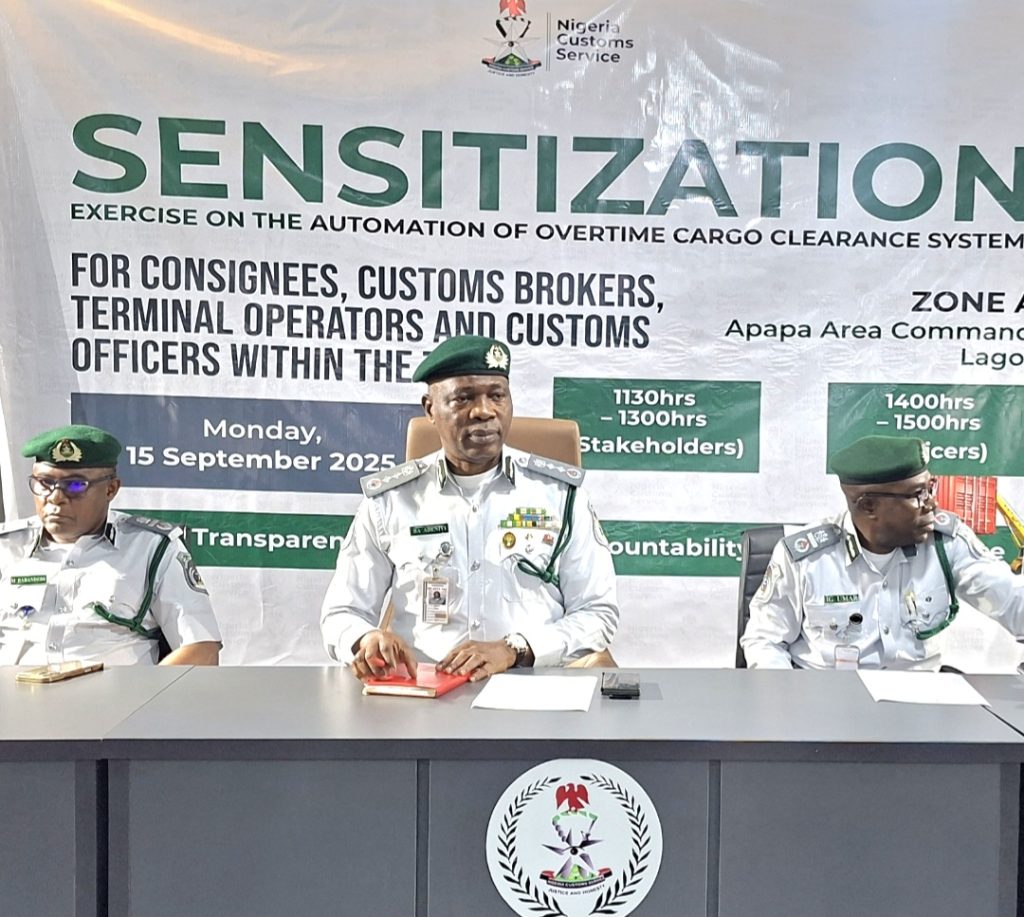
Comptroller-General of Customs, Bashir Adewale Adeniyi (middle) flanked by ACG Headquarters, Isah Umar and ACG Zone A, Mohammed Babandede at the Apapa command on Monday for sensitization of stakeholders on the new automation of overtime cargo clearance system
By DAPO OLAWUNI
In order to ensure simplified clearance processes, ease of doing business, and transparency in the disposal of overtime cargoes, the Nigeria Customs Service has announced the automation of overtime cargo clearance system across all ports in Nigeria.
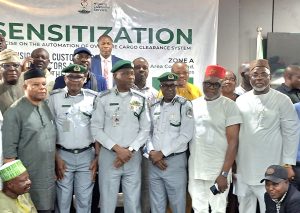
Comptroller General of Customs, Bashir Adewale Adeniyi who disclosed this at the sensitization of stakeholders on the new system held at Apapa Customs Command on Monday, acknowledged that the automation process is imperative because more than 50percent of the letters, emails, and complaints being received on his table on daily basis, have to do with the management of overtime cargoes.
The Customs boss also said that a special desk has been created at the customs headquarters Abuja, in order to prioritise project cargoes being imported by government agencies. He assured that the essence of automating the process is not for revenue generation, but to ensure efficiency in the cargo clearance process.
Speaking, he said “Our objective is not about making revenue, our objective for deploying these systems includes to facilitate trade, to get imported goods to their owners. But more importantly, we want to manage space so that other imports that are coming can have space in our ports and then they can be cleared in a very swift manner.
“So this system will be deployed and we will appreciate the feedback that we are going to be getting from our stakeholders.

“What this means is that all of these challenges that bedevils the process of management of overtime cargo are real, and they have to be confronted.
We are more interested in exiting these cargoes from our ports, rather than managing them as overtime.
“One of the things that I have done was to set up specialized desks at headquarters and in different commands to manage imports done by government and government agencies. We don’t want those imports to stay one day longer.
“Projects that address issues of power infrastructure, road infrastructure, public health, education, all of those projects are very vital to delivering on dividends of democracy to Nigerians and we would not want them to be abandoned in the port, to stay longer in our ports. And irrespective of their status, the directive I always give to all our controllers is that we must weigh all processes and procedures and ensure that those consignments are taken out of our ports.
“The same goes for consignments imported by members of the organized private sector and the Manufacturers’ Association of Nigeria and other organized groups.
“We know that through these imports, they reflect our economy, and we don’t want them to be delayed in our port. We also give reference to our embassies and consignments that are imported by international organizations, missions, and diplomatic agencies.
“So we also have special desks that have been created for them. So I need to state it here for Nigerians. I need to reiterate and reemphasize the fact that revenue is not the aim, it is not the objective of what we are doing.
“We have the objective of injecting transparency, of reducing corruption, of making the system more efficient.The objective that we do not have in mind in putting this system is revenue. And I’ll just give you an example. In 2024, our revenue profile rose to 6.3 trillion Naira, less than 1% of that was from overtime cargoes.”
CGC Adeniyi assured that the sensitization is continuing in the course of the week as there would be an interaction and consultation with terminal operators and shipping companies, especially as it concerns demurrages and rents on overtime cargoes.
“I will direct the Zonal Coordinator to organize more of these platforms starting from during this week. Specifically, we will be targeting terminal operators and shipping companies first alone.
We will also do the same thing in all the commands, and then the Customs agents” he assured
Speaking earlier on the benefits of the automated overtime cargoes clearance system, ACG Headquarters of Customs, Isah Umar said that the Nigeria Customs Service seeks to benefit from the deployment of the Overtime E-clearance System In terms of simplified clearance process, ease of doing business, transparency of process, and Data integrity.
Other benefits listed from the system include; electronic records of disposal; educed human interaction; automate records of disposals; Improving Import/export data integrity; Streamlined processes and procedures for the disposal of Overtime Cargo; Establish harmonious and automated document flow.
Umar said the automated process would elimimate any form of breach of procedure or disposal of overtime cargo that has not exhausted its dwelling period.
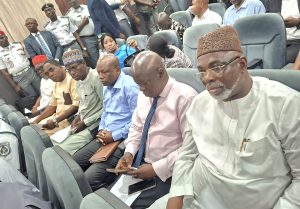
Stakeholders present at the sensitization programme commended the initiative of the Nigeria Customs Service under Bashir Adewale Adeniyi, even as they took time to share their thoughts during an interactive session.

Prince Segun Oduntan, Vice President of Association of Nigerian Licensed Customs Agents (ANLCA) noted that the automation of overtime cargoes would put an end to constant congestion inside the nation’s port terminals and ensure easy clearance of cargoes.
He urged Customs to look into the issue of criminals who would want to bastardize the system, saying that “I am happy the CGC has assured us of that. On the part of terminal operators, they don’t have any choice than to key into the new system because the turn around of their yard space is more important than what they get from overtime
“We are going to advice the service further in our subsequent engagement, they should ensure that anybody that deliberately abandon their cargoes inside the port must not be a beneficiary of the disposal process of that cargo ” he said
Also speaking, the General Manager, Ports and Terminal Multiservices Limited (PTML), Mr. Babatunde Keshiro recommended that the automated system should be structured in a way that prevent deliberate jettisoning of goods at port for overtime to invade import duty and other port charges.
He, however, assured that PTML will continue to partner with the NCS in ensuring the new automated system works perfectly.