

Nigeria Customs Announce 12-Years Age Limit for Imported Vehicles

Col Hameed Ali, Customs Comptroller General
…As VIN Valuation Implementation Kicks Off
By DAPO OLAWUNI
The Nigeria Customs Service has announced changes in the age limit of vehicles coming into the country from 15-years down to 12-years, warning that henceforth, any importer that brings vehicles older than 12-years shall be impounded.
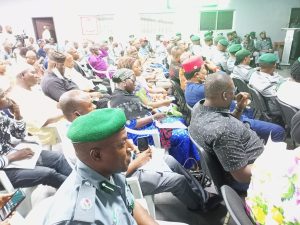
This indication was given on Thursday during the demonstration and sensitization of stakeholders on the new Vehicles Identification Number (VIN) Valuation Policy of the customs held at the Apapa Customs command.
Comptroller Anthony Udenze of the Tariff and Trade Department at Customs headquarters first gave the indication, saying that the age limit for vehicles have been reduced to 12years.
This point was later reiterated by the National Public Relations Officer of Customs, Deputy Comptroller Timi Bomodi, saying that a car of 2007 would be impounded by the service.

He was responding to plea by freight forwarders that customs should maintain status quo on the 15years age limit, as this is what importers are working with.

“This policy is not a new policy, if you import a 2007 car, it would nbr seized, if you bring a vehicle that is older than what the government allow, it would be seized” he warned.
Meanwhile, the customs has announced that the VIN Valuation Policy is kick-starting today 20th of May 2022 at the ports.
The VIN valuation was first introduced about two months ago, but it was greeted with uproar from the freight forwarders who described the policy as inhuman and unrealistic due to the high values imposed on vehicles, and the lack of consideration for rebate on accidented and used vehicles.
This led to the suspension of the system by the customs authority which thereafter reworked and improved the policy by accommodating the observations and grievances of freight forwarders.
Speaking at the stakeholders meeting, Customs Area Controller of Apapa Customs, Compt Yusuf Malanta who hosted the program, assured that there is going to be a continuous engagement between customs and the freight forwarders over the policy.
According to him, a help desk would also be created to treat all complaints emanating from the use of the VIN Valuation platform.
He enjoined the stakeholders to take full advantage of the automated system which he said would make goods clearance procedure seamless and faster.
While welcoming the stakeholders earlier to the sensitization meeting, Comptroller Yusuf urged them to be compliant with the extant guidelines to enable them to enjoy the benefits of the new system.
He assured them help desk would be created in each of the commands to help resolve the teething problems that are bound to crop up, adding that there would be continuous engagement and improvement on the new valuation policy.
He told the stakeholders that the VIN valuation policy is irreversible and will be deployed this Friday, May 20th, 2022.
Comptroller Festus Okun, the Customs Area Controller of Ports Terminal Multiservices Limited (PTML) Command also said the Customs, through the VIN valuation, has imbibed basic principles of taxation which include predictability, neutrality, simplicity, and efficiency.
Comptroller Kunle Oloyede of Tin Can Island Port, described VIN as a platform for robust gathering of statistical analysis and data for national economic purposes relying on the template of accuracy that will further integrate NCS with other ministries, departments and agencies.
Comptroller Hammi Swomen of Kirikiri Lighter Terminal Command, who sought more cooperation from all stakeholders, stated that sincere declarations without tampering with relevant information contained in Single Goods Declaration or mismatching information will aid in quicker clearance and seamlessness of the VIN system.
Comptroller Anthony Udenze of the Tariff and Trade Department at Customs headquarters urged vehicle importers and their agents to avoid acts that would delay the process of clearing.
He explained that the process of identifying salvage and accident vehicles under the VIN regime would be very transparent as the declarant would be expected to attach photos showing the accidented vehicles.
He further explained that for vehicles to be treated as accidented, the chassis must be affected by the accident not just by removing fenders, bumpers and headlamps.
In their various reactions, freight forwarders who attended the sensitization expressed divergent views. While some of them expressed their support and acceptance of the platform, some of them kicked against the value attached to the system.
Speaking, Mr Francis Aniezechukwu of Association of Nigeria Licensed Customs Agents (ANLCA) at PTML chapter, frowned at the short notice given to the freight forwarders before customs is commencing implementation. He called for more time for freight forwarders to digest the new changes on the VIN Valuation before it is fully deployed.
Another speaker, Mr Anthony Okolie of the National Council of Managing Director of Licensed Customs Agents (NCMDLCA) at PTML Chapter, argued that the value imputed into the system is not in comformity with the General Agreement on Trade and Tariff.
However, Acting President of ANLCA, Dr Kayode Farinto urged freight forwarders to comply with the new VIN Valuation which according to him has come to stay.
He said that in order to get to the level whereby vehicles would be released automatically (auto release) freight forwarders need to improve their level of compliance.
On his part, former President of National Association of Government Approved Freight Forwarders (NAGAFF) Dr Eugene Nweke said the VIN Valuation would put an end to the continuous harassment of freight forwarders by various customs units like the Federal Operations Unit (FOU) among others.
“Whenever any officer arrests a vehicle that has been exited under the VIN regime, that officer himself should be arrested. No FOU should stop vehicles again”
Dr Nweke also said it would be wrong for the customs to continue request for Pre Arrival Assessment Report (PAAR) on new vehicles since the VIN valuation is here to work out all duties payable on the cars.


Make more money for the government instead of you compounding older cars above 12yrs, any car above 12yrs should be given a fine of 10,000naira per year downward…every country in the world have older cars which enable them to pay higher insurance and that insurance is then remit to there government for the mentainance of there road
All this information now is not favor Masses because alot of Nigerians would back to unemployment and begging on the street to survive again ,you people should think on another alternative because you’re making calm down ,and many graduate are working under agency to survive .I will pleading the NCS to bring it down to 2008 vehicles .so that it will helping us to survive in the country because Nigeria economy now is very poor .
I can confidently say this is a dead on arrival policy because millions of Nigerians feed on those imported cars i e technicians, commercial businesses of various types, Clearing agent & those behind the policy should consider the cost effect as underage vehicles belong to common Nigerians.
This policy may bring more hands into crimes because If you can’t provide work for common man remember not to take the one @ hand,
Nigerians doesn’t deserve any hard policy now because of the present situation of her economy except the leader are not sincere with the present situation of my lovely Nation Nigeria. I therefore apeal to the concern authorities to tamper justice with mercy.
This policy is to further prove that Nigeria government are anti people. Millions of people are managing from these tokunbo vehicles; graduates that turn clearing agent, Mechanic, auto electrician, People driving Uba, etc. Is so sad that a government that can not provid jobs for her citizens will be going after the little once people are managing. Now, tell me how many Nigerians can afford vehicles of 2010 up ward. I don’t know what is actually going on, go to Europe, American, Canada all these vehicles are still driven Cotonu agents are already rejoicing since the news broke out. No matter what you put in place you can never stop this age bracket of vehicles Nigeria government ban from getting into the country because this is what average Nigerian that is not in government can afford.
In all fairness Nigeria is the only nation that does not consider the effects of their policies to the masses. Before any nation comes up with a new policy, they first consider how such policy will affect the masses and the economy. If they have to carry out such policies, they give the public a time frame.
This is never the case with Nigerian policy maker’s.
How can policies that will cost economic hardship to 90% of the population be so urgent and immediate.
It’s only in Nigeria that those struggling to survive goes to bed at night and get up in the morning with all their belongings on the street.
Who are these people representing? Who are they working for? And are those to be affected not Nigerians?
I suggest they rethink their decisions, give the public a time frame to be able to adjust. Bring the age limit to 10 years and to effectively carry out the age limit policy, the shipping line should be held responsible for bringing under age vehicle to the country.
Our policy maker’s should stop all these fire brigade approach on policies. It is causing untold economic hardship to the same Nigerian people they suppose to help.
They wake up after a bad dream and announce changes without due consultation taking Nigerians as the focus for such changes. Life is difficult in Nigeria like someone said why not impose a fine on cars between 12 and 20 years. Cars on Nigerian roads are so bad that it should be replaced regularly and good roads built. Vehicles should be checked yearly for roadworthiness like MOT.